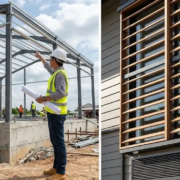
Pensive architect woman in a safety helmet reviewing building model and blueprints in the office.

What Permits Are Needed to Build a House in Costa Rica?

Building a house in Costa Rica is an exciting plan for many people, especially retirees, investors, and families relocating from abroad. The country offers stable property ownership, beautiful natural surroundings, and a strong construction market. However, one of the most confusing parts of the process is understanding permits.

Many first time builders ask the same question at the start. What permits are needed to build a house in Costa Rica? The permit process is mandatory, structured, and strictly enforced. Without the correct approvals, construction cannot legally begin.

This guide explains the full permit process in simple and clear language. You will learn which permits are required, who approves them, how long the process takes, and what happens if permits are skipped. This information is especially important for foreigners who want to avoid delays, fines, or legal problems.

Why Permits Are Required for House Construction in Costa Rica

Costa Rica requires building permits to protect public safety, the environment, and property owners. Homes must meet structural, zoning, and environmental standards before construction begins.

The country is located in an earthquake prone region with heavy rainfall and varied terrain. Poorly planned construction can cause serious safety risks. Permits ensure that homes are designed and built according to national building codes.

Permits also help municipalities control land use. This prevents overcrowding, protects natural resources, and ensures proper access to utilities such as water, roads, and electricity.

Overview of the Costa Rica Building Permit System

The building permit system in Costa Rica involves both national and local authorities. It is not a single approval but a combination of reviews and authorizations.

Most residential projects must go through a digital approval system and the local municipality where the property is located. Each authority reviews different aspects of the project.

Because of this layered system, permits can take time. Proper planning and professional support are essential to move through the process smoothly.

Architectural Plans Approval

The first and most important requirement is approved architectural plans. These plans show the layout, dimensions, materials, and design of the house.

Architectural plans must be prepared and signed by a registered architect. Municipalities will not accept plans created by unlicensed individuals.

These plans are reviewed to confirm compliance with zoning rules, setbacks, height limits, and safety standards. Without approved architectural plans, no other permits can move forward.

Structural Engineering Approval

In addition to architectural plans, structural engineering approval is required. This ensures the house can withstand earthquakes and other natural forces.

A licensed structural engineer prepares calculations and drawings for foundations, columns, beams, and slabs. These documents prove that the structure meets national seismic codes.

Structural approval is mandatory for all residential homes. Skipping this step is not allowed and will result in permit rejection.

Municipal Building Permit

Once the plans are approved, a municipal building permit is required. This permit authorizes construction within a specific local government area.

The municipality reviews the project for zoning compliance, land use classification, and local regulations. They also confirm that property taxes are up to date.

Construction cannot legally begin until the municipal permit is issued. Inspectors may visit the site during construction to ensure compliance.

Environmental Permits and Assessments

Some projects require environmental approval before construction can begin. This depends on the location, size of the project, and surrounding land conditions.

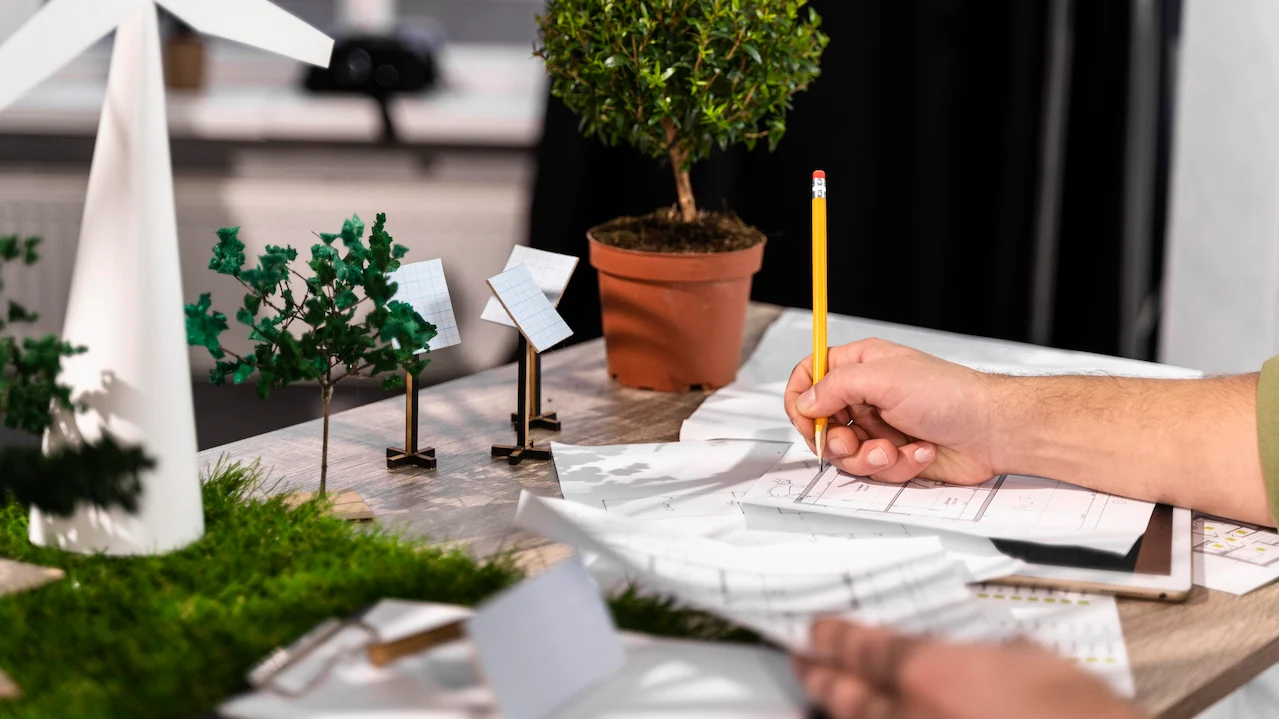
Close-up of a person working on an eco-friendly wind power project, drawing plans with a pencil and reviewing paper schematics.

Homes near protected areas, rivers, coastlines, or forests may require an environmental assessment. This ensures the project does not harm natural ecosystems.

Not all residential projects require full environmental permits, but many require at least a basic environmental clearance. This step is often overlooked and can cause serious delays if ignored.

Water Availability and Utility Permits

Before building, proof of water availability is required. Authorities must confirm that the property has legal access to potable water.

This approval may come from a local water association or a national utility provider. Without water approval, construction permits will not be granted.

Electricity access and septic system approval may also be required, depending on the location. These permits ensure the home can safely connect to essential services.

Permits Required for Renovations and Additions

Permits are not only required for new homes. Many renovations and additions also require approval.

If you are adding rooms, changing the structure, modifying the roof, or expanding the building footprint, permits are required. These changes affect safety and zoning compliance.

Minor cosmetic changes such as painting or replacing finishes usually do not require permits. However, it is always best to confirm before starting work.

Permit Requirements for Foreign Property Owners

Foreigners are allowed to build homes in Costa Rica, but they must follow the same permit rules as local citizens.

There are no special exemptions for foreign property owners. All plans, approvals, and inspections are required regardless of nationality.

Because the process is conducted in Spanish and involves local systems, foreigners often benefit from professional permit management support.

How Long Does the Permit Process Take in Costa Rica?

Permit timelines vary depending on the project size, location, and complexity. On average, residential permits can take several weeks to several months.

Projects that require environmental approvals or multiple revisions may take longer. Municipal workloads and seasonal demand also affect timelines.

Proper documentation, accurate plans, and professional coordination can significantly reduce delays.

Cost of Building Permits in Costa Rica

Permit costs vary based on project value and municipality. Fees are usually calculated as a percentage of the estimated construction cost.

Additional costs may include professional fees for architects, engineers, and permit consultants. These costs should be included in the project budget from the beginning.

Trying to avoid permit costs often leads to much higher expenses later due to fines, delays, or required corrections.

What Happens If You Build Without Permits

Building without permits in Costa Rica is illegal and risky. Authorities can issue stop work orders that immediately halt construction.

Fines and legal penalties may apply. In some cases, unpermitted structures must be modified or demolished to meet regulations.

Unpermitted construction also creates problems when selling the property. Buyers, banks, and insurers often require proof of legal construction.

Importance of Professional Permit Management

The permit process involves technical documents, multiple authorities, and strict compliance requirements. Managing this alone can be overwhelming.

Architects, engineers, and permit specialists coordinate submissions, respond to review comments, and track approvals. Their experience helps avoid common mistakes.

Professional permit management saves time, reduces stress, and protects your investment.

Planning Ahead for a Smooth Permit Process

Good planning is the key to successful permit approval. Understanding requirements early prevents costly delays.

Before purchasing land or starting design, confirm zoning rules, utility availability, and environmental restrictions. This information shapes the entire project.

With the right preparation and guidance, the permit process becomes manageable and predictable.

Conclusion

Building a house in Costa Rica requires proper planning, and permits are a critical part of the process. Every residential construction project must follow legal approval steps to ensure safety, zoning compliance, and environmental protection.

From architectural and structural approvals to municipal and utility permits, each requirement plays an important role. Skipping even one permit can lead to delays, fines, or serious legal problems later.

Understanding permit requirements early helps you plan better, control costs, and avoid unnecessary stress. When handled correctly, the permit process becomes a clear and manageable part of building your home in Costa Rica.

Why Choose Finish Touch Enterprises

Finish Touch Enterprises helps homeowners navigate the entire permit process in Costa Rica with clarity and confidence. We understand local construction laws, municipal requirements, and approval procedures across different regions.

Our team works closely with architects, engineers, and local authorities to ensure every permit is prepared correctly and submitted on time. We help identify requirements early, prevent common mistakes, and reduce approval delays.

We specialize in supporting foreigners and first time builders who need reliable guidance throughout the permitting and construction process. With our experience, your project stays compliant, organized, and on schedule.

Frequently Asked Questions

Do I need a permit to build a house in Costa Rica?

Yes. All residential construction projects require permits before construction can legally begin.

Who approves building permits in Costa Rica?

Building permits are approved by local municipalities along with national review systems that verify architectural and structural compliance.

How long does it take to get a building permit in Costa Rica?

Permit timelines vary by project and location. Most residential permits take several weeks to a few months when documents are prepared correctly.

Can foreigners apply for building permits in Costa Rica?

Yes. Foreigners can build homes but must follow the same permit rules and approval process as Costa Rican citizens.

What happens if I build without permits?

Authorities can issue stop work orders, fines, and legal penalties. Unpermitted construction can also cause problems when selling or insuring the property.

Are permits required for home renovations?

Yes, if the renovation involves structural changes, additions, or modifications that affect safety or zoning compliance.

How much do building permits cost in Costa Rica?

Permit costs vary by municipality and project value. Fees are usually based on a percentage of the construction cost.

Can permit delays be avoided?

Yes. Accurate plans, proper documentation, and professional permit management greatly reduce delays.

Architects and modern home construction in Costa Rica with AR technology and building permit approva

Do I Need an Architect to Build a House in Costa Rica?


Building a house in Costa Rica is a dream for many people, especially retirees, investors, and families moving from abroad. The country offers beautiful landscapes, a relaxed lifestyle, and strong property ownership rights for foreigners. However, the construction process can feel confusing if you are new to the local rules and systems.

One of the most common questions people ask at the very beginning is simple but very important. Do I need an architect to build a house in Costa Rica? The short answer is yes in most cases, but the full answer depends on the type of project, the size of the house, and the permits involved.

This guide explains everything clearly in simple language. You will learn when an architect is legally required, why architects play such an important role, how the permitting system works, and what risks you face if you try to build without proper architectural involvement. This information is especially helpful for foreigners who want to avoid costly mistakes and delays.

Understanding the Construction System in Costa Rica

Before discussing architects, it is important to understand how construction works in Costa Rica. Unlike some countries where builders can handle everything, Costa Rica follows a regulated system that separates design, approval, and construction responsibilities.

Construction projects are controlled by national and local authorities. These authorities require professionally prepared plans before any building permit is issued. The plans must meet safety, zoning, environmental, and infrastructure standards.

Costa Rica takes building safety seriously due to earthquakes, heavy rainfall, and tropical conditions. Because of this, the law requires trained professionals to design and review residential structures. Architects are one of those key professionals.

Is an Architect Legally Required to Build a House in Costa Rica?

In most residential construction projects, an architect is legally required. Costa Rican law requires architectural plans for new home construction, major renovations, and structural changes. These plans must be prepared and signed by a registered architect.

Without an architect, you cannot obtain a legal building permit. Municipalities will not approve construction documents unless they are submitted by licensed professionals who are registered with the national professional associations.

There are very limited exceptions, usually for extremely small or simple structures, such as minor sheds or non habitable buildings. Even in those cases, approval is not guaranteed and depends on the municipality.

For any normal house intended for living, an architect is required.

Why Costa Rica Requires Architects for Residential Construction

Costa Rica requires architects to protect homeowners, communities, and the environment. Architects are trained to design homes that are safe, functional, and compliant with national codes.

One major reason is earthquake safety. Costa Rica sits in an active seismic zone. Buildings must be designed correctly to reduce the risk of collapse during earthquakes. Architects coordinate with engineers to ensure the structure meets these standards.

Another reason is land use control. Architects ensure that homes respect zoning rules, setbacks, height limits, and environmental protections. This helps prevent illegal construction that could harm neighboring properties or protected land.

Architects also ensure homes are suitable for the tropical climate. Proper ventilation, roof design, drainage, and material selection are critical in Costa Rica.

Role of an Architect in the House Building Process

An architect in Costa Rica does much more than draw floor plans. Their role covers multiple stages of the project.

First, the architect evaluates the property. This includes checking zoning regulations, access roads, utility availability, and environmental restrictions. This step prevents serious problems later.

Second, the architect designs the house. This includes layout, elevations, materials, and technical drawings. The design must meet your needs while following local laws.

Third, the architect prepares permit documents. These are submitted to the municipality and national review systems. The architect communicates with authorities and responds to revision requests.

Finally, the architect often provides construction oversight. This helps ensure the house is built according to approved plans and reduces costly errors.

Architect vs Builder Responsibilities in Costa Rica

Many people confuse the roles of architects and builders. In Costa Rica, these roles are clearly separated.

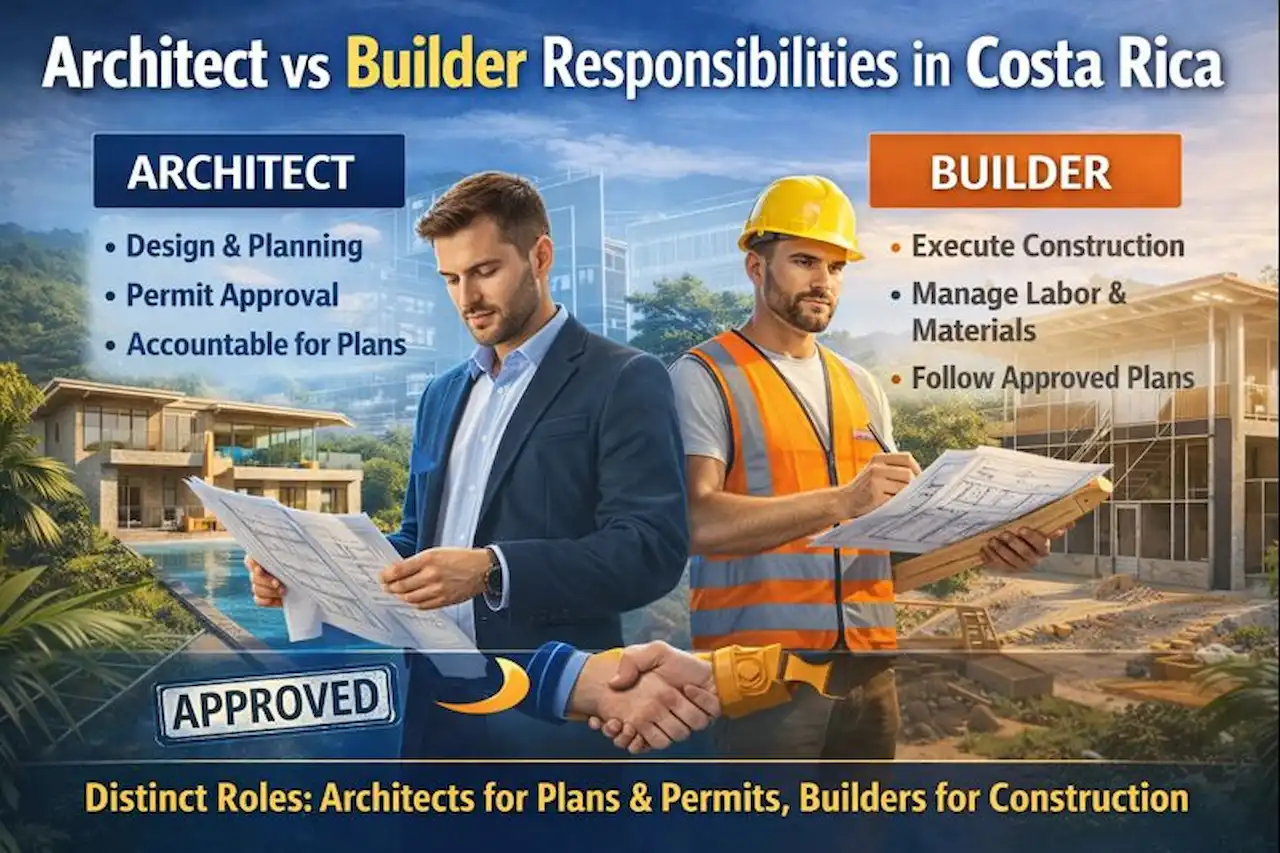
Architect vs Builder responsibilities in Costa Rica, highlighting their distinct roles in construction projects.

An architect is responsible for design, planning, and permit approval. They are legally accountable for the accuracy and compliance of the plans.

A builder or contractor is responsible for executing the construction work. They follow the approved plans and manage labor, materials, and timelines.

A builder cannot legally replace an architect. Even if a builder has experience, they cannot submit architectural plans unless they are licensed as an architect.

For best results, the architect and builder work together from the beginning.

Do Foreigners Need an Architect to Build in Costa Rica?

Yes, foreigners are subject to the same construction laws as Costa Rican citizens. There are no special exemptions for foreign property owners.

In fact, architects are even more important for foreigners. Language barriers, unfamiliar regulations, and local procedures can easily lead to mistakes. A local architect helps navigate these challenges.

Architects also help foreigners understand realistic budgets, timelines, and construction standards. This protects your investment and reduces stress.

If you plan to build while living outside Costa Rica, an architect becomes essential for coordination and oversight.

When an Architect Is Required for Renovations and Additions

Architects are not only required for new homes. Many renovation projects also require architectural involvement.

If you are changing the structure, adding rooms, modifying the roof, or expanding the footprint of the house, architectural plans are required. These changes affect safety and zoning compliance.

Minor cosmetic updates like painting or replacing finishes usually do not require permits or architects. However, anything structural should always be reviewed by an architect first.

Failing to use an architect for renovations can result in fines, stop work orders, or problems when selling the property.

The Permit Approval Process and the Architect’s Role

The permit process in Costa Rica involves multiple steps, and architects manage most of it.

Architects prepare drawings and submit them to the national digital review system and the local municipality. The plans are reviewed for zoning compliance, safety, and infrastructure impact.

Authorities may request revisions. The architect updates the plans and resubmits them. This process can take weeks or months depending on the project and location.

Without an architect, navigating this process is extremely difficult and often impossible. Municipal offices will not communicate directly with unqualified individuals regarding technical plan approvals.

What Happens If You Try to Build Without an Architect?

Building without an architect in Costa Rica is risky and usually illegal.

If construction begins without approved plans, authorities can issue a stop work order. This halts the project immediately. You may also face fines and legal penalties.

Unpermitted construction can create serious problems when selling the property. Buyers and banks often require proof that the house was built legally.

Insurance claims may also be denied if the house was built without proper approval. In extreme cases, authorities can require demolition of illegal structures.

These risks far outweigh any short term savings.

Cost of Hiring an Architect in Costa Rica

Many people worry about the cost of hiring an architect. In reality, architectural services are a small percentage of the total construction budget.

Architect fees vary depending on project size, complexity, and level of involvement. Some architects charge a percentage of construction cost, while others offer fixed fees.

Hiring an architect often saves money in the long run. Good design reduces construction errors, material waste, and costly changes during building.

Architects also help avoid legal problems that could cost far more than their fees.

Choosing the Right Architect for Your Home Project

Not all architects are the same. Choosing the right one is important.

Look for an architect with experience in residential construction in Costa Rica. Local knowledge matters more than impressive portfolios from other countries.

Communication is critical. Your architect should explain things clearly and respond promptly to questions.

It is also helpful to choose an architect familiar with the region where you plan to build, such as Guanacaste. Local experience helps speed up approvals and avoid regional issues.

How Architects Improve the Overall Building Experience

Beyond legal requirements, architects improve the entire building experience.

They help translate your ideas into practical designs. They balance aesthetics, budget, and functionality. They anticipate problems before they happen.

Architects act as your advocate during construction. They help ensure contractors follow the plans and maintain quality standards.

For many homeowners, the architect becomes the most trusted advisor throughout the project.

Planning Ahead Before Hiring an Architect

Before hiring an architect, it helps to prepare.

Think about your budget, timeline, and lifestyle needs. Consider how you will use the home now and in the future.

Gather basic information about the property, including location, size, and any existing structures. This helps the architect assess feasibility quickly.

The more prepared you are, the smoother the design and approval process will be.

Conclusion

So, do you need an architect to build a house in Costa Rica? In most cases, the answer is yes. For any residential home intended for living, an architect is legally required to prepare plans, obtain permits, and ensure the house meets safety and zoning regulations.

Beyond legal requirements, an architect protects your investment. They help you avoid costly mistakes, delays, and compliance issues. This is especially important if you are new to Costa Rica or building from abroad.

Trying to build without an architect often leads to serious problems, including stop work orders, fines, and difficulty selling the property later. When you consider the long term value and peace of mind, hiring an architect is not just a requirement. It is a smart decision.

Why Choose Finish Touch Enterprises

Finish Touch Enterprises offers complete design and build solutions for homeowners in Costa Rica. We understand local construction laws, permitting systems, and regional building requirements.

Our team works closely with licensed architects, engineers, and construction professionals to ensure every project is compliant, safe, and well planned from the start. We guide our clients through each step, from concept design to final construction.

We specialize in helping foreigners and first time builders who need clear guidance and honest communication. Our experience across Costa Rica, especially in Guanacaste, allows us to prevent common issues that delay projects and increase costs.

When you work with us, you get one team managing design, permits, and construction with transparency and accountability.

Frequently Asked Questions

Can I build a house in Costa Rica without an architect?

In most cases, no. Residential homes require architectural plans prepared by a registered architect to obtain legal building permits.

Is an architect required for small houses in Costa Rica?

Even small houses usually require an architect if they are meant for living. Only very small non habitable structures may qualify for limited exceptions.

Do foreigners need an architect to build in Costa Rica?

Yes. Foreigners follow the same construction laws as locals. An architect is required for permits and approvals.

Can a builder replace an architect in Costa Rica?

No. Builders cannot submit architectural plans unless they are licensed architects. Both roles are legally separate.

How much does it cost to hire an architect in Costa Rica?

Costs vary based on project size and complexity. Architectural fees are usually a small percentage of total construction cost and often save money in the long run.

Do renovations require an architect in Costa Rica?

Structural renovations, additions, or layout changes usually require architectural plans and permits. Minor cosmetic updates do not.

How long does the permit process take with an architect?

Permit timelines vary by municipality and project scope. Having an experienced architect helps reduce delays and revision requests.

What happens if I build without permits in Costa Rica?

Authorities can issue stop work orders, fines, and legal penalties. Unpermitted construction can also cause problems when selling or insuring the property.


Building a Custom Home in Costa Rica: The Complete 2026 Handbook

Build a Retirement Home in Costa Rica: Complete Guide for US & Canadian Buyers

The American Dream has evolved. For many North Americans, the ideal retirement no longer involves suburban quiet, but tropical vitality waking up to Pacific views rather than snow drifts. Costa Rica remains the premier destination for this lifestyle shift, offering world-class biodiversity and a focus on wellness. 

However, the path from vision to reality is complex. Building a custom home here requires navigating a unique legal and cultural framework that differs vastly from the US or Canada. This guide serves as your strategic roadmap for 2025, deconstructing the entire process from securing critical water rights to selecting climate-resilient materials to ensure your investment is secure and your transition seamless.

Why Costa Rica Remains the Top Choice for North American Retirees

Before diving into the logistics of concrete and permits, it is worth reaffirming why this investment makes sense. Beyond the tropical climate, Costa Rica offers a stability that is rare in the region. It is one of the few countries where foreigners enjoy the same property ownership rights as locals. You do not need a local partner or a complex bank trust (fideicomiso) to hold the title to your home, unlike in Mexico.

Furthermore, the expat infrastructure is mature. Whether you are looking at the Gold Coast in Guanacaste, the Southern Zone near Uvita, or the Central Valley, you will find established communities of English speakers. This network provides a soft landing, allowing you to navigate the Caja (social healthcare system) or find the best private clinics with guidance from those who have done it before.

But perhaps the biggest draw is the ability to build a custom luxury home for a fraction of the cost of a comparable build in California, Florida, or British Columbia. While prices have risen in 2025, the value proposition remains undeniable: you can still build a high-end, architectural masterpiece with ocean views for a price that might only get you a modest condo in Miami or Vancouver.

Step 1: Buying Land (The Lote) – Where Dreams Meet Reality

The most critical decision you will make is not the color of your tile or the shape of your pool; it is the land you buy. In North America, when you buy a lot in a subdivision, you assume it comes with water, electricity  andinternet. In Costa Rica, you must never assume.

The Water Letter is Gold

In provinces like Guanacaste, water availability is the single biggest hurdle for new construction. You might find a stunning lot with a panoramic ocean view, but if the local ASADA (water association) cannot issue a Water Letter (Carta de Disponibilidad de Agua), you cannot get a building permit. It does not matter how much money you have; without that letter, you cannot build.

Before you sign any purchase agreement, ensure your due diligence includes verifying the water source. Is it a public hookup? Is it a registered well? If the seller promises water is coming soon, walk away or wait until it is physically there.

Topography and Site Prep

Costa Rica is mountainous. That breathtaking view usually implies a steep slope. Buyers often underestimate the cost of earthworks required to make a steep lot buildable. You may need extensive retaining walls, soil stabilization  anddrainage management to handle the green season rains.

This is why why site preparation is crucial before building in Costa Rica. A cheap lot with a steep grade can easily cost $50,000 to $100,000 more in site prep than a flat, more expensive lot. Always have a builder or engineer visit the site before you close the deal to estimate the invisible costs of the dirt work.

Step 2: The Legal Framework and Permitting Maze

Once you own the land, the administrative marathon begins. Costa Rica is a bureaucratic country  andthe permitting process involves multiple government agencies. For US and Canadian buyers accustomed to a streamlined city hall process, this can feel slow. However, if you understand the steps, it is manageable.

The Preliminary Studies

Before an architect draws a single line, you need technical data.

  • Topographic Survey: An exact map of your land’s contours.
  • Soil Study: Essential for structural engineering to determine the type of foundation needed (especially in seismic zones).
  • Uso de Suelo: A document from the municipality confirming what you are allowed to build on that specific lot (residential, commercial, height restrictions, etc.).

The Permitting Roadmap

In 2025, the permitting process has become more digitized via the APC (Administrador de Proyectos de Construcción) system, but it still requires human review at every stage.

  1. CFIA Approval: Your architect submits the complete blueprints to the Colegio Federado de Ingenieros y de Arquitectos (CFIA). They check for code compliance and seismic safety.
  2. Fire Department (Bomberos): Required for larger homes or commercial projects.
  3. Ministry of Health: Ensures the septic or sewage plans meet environmental standards.
  4. Municipal Permit: The final boss. Once all other agencies approve, the local municipality reviews the file and issues the building permit. This is also when you pay the building tax (usually 1% of the estimated project value).

Navigating this alone is impossible for a foreigner. You need a team that acts as your advocate on the ground. A specialized design & permitting expert in Costa Rica can often cut weeks or even months off this timeline by ensuring every document is formatted correctly before submission, preventing the dreaded returned for correction status.

Step 3: Designing for the Tropics

Coming from North America, your instinct might be to build a sealed, air-tight home with heavy insulation to keep the AC in. In Costa Rica, that is often a mistake. Tropical modern architecture focuses on passive cooling using the environment to keep the home comfortable without running the AC 24/7.

Ventilation and Orientation

Your architect should study the sun path and wind direction on your specific lot. Large overhangs (eaves) are mandatory to protect walls from heavy rain and to shade windows from direct solar heat. Cross-ventilation placing windows on opposite sides of a room allows the ocean breeze to flush out hot air naturally.

The Indoor-Outdoor Connection

Retirement in Costa Rica is about living outside. Your terrace is arguably more important than your living room. We often see designs that allocate huge square footage to indoor dining rooms that are rarely used, while the outdoor covered terrace is too small.

Design your home with flex spaces. Large sliding glass doors or folding walls can erase the boundary between the kitchen and the pool deck, effectively doubling your living space. However, this requires high-quality PVC or aluminum window framing that won’t warp in the humidity or corrode in the salt air.

Materials Matter

This is where the Canadian Cabin or Florida Stucco mindset needs an adjustment.

  • Wood: While beautiful, wood requires high maintenance in the tropics due to termites and sun damage. Use it sparingly or opt for local hardwoods like Teak or Guanacaste that are naturally resistant.
  • Steel & Concrete: These are the kings of Costa Rican construction. They are seismic-resistant, termite-proof  andcool.
  • Roofing: Clay tiles look traditional but are heavy and can crack. Modern metal standing seam roofs or synthetic tiles often offer better longevity and leak protection during the torrential rains of October.

Step 4: Decoding Construction Costs in 2025

The most common question we receive from US and Canadian clients is: How much does it cost per square foot?

In 2025, the answer has shifted. Post-pandemic inflation on materials like steel and cement has stabilized, but labor costs and skilled craftsmanship premiums have risen. If you are reading forums from 2019 quoting $100 per square foot for luxury builds, you are looking at outdated data.

The Reality of Price Per Square Foot

Be very careful when comparing builder quotes based solely on this metric. A quote of $120/sq. ft. might include only the grey shell (walls and roof) with no finishes, plumbing fixtures, or cabinetry. A quote of $200/sq. ft. might be turnkey, including premium porcelain floors, quartz countertops  andLED lighting.

For a high-quality, custom home suitable for North American standards (hot water throughout, grounded electricity, quality windows), you should budget within these ranges for 2025:

  • Standard Finishes: $160 – $190 per sq. ft.
  • Premium/Luxury Finishes: $200 – $280+ per sq. ft.

The Hidden Costs

When budgeting, do not forget the line items that sit outside the main construction contract:

  • Professional Fees: Architects and engineers typically charge 10-15% of the estimated construction value.
  • Permits & Insurance: The building permit (1%) and the mandatory worker’s insurance (INS) can add another 2-3% to the total budget.
  • Landscaping & Pools: A pool is often treated as a separate line item. A standard infinity pool can range from $25,000 to $50,000 depending on the complexity and equipment.

To get a granular breakdown of where your money goes from the foundation to the final coat of paint review our detailed breakdown on house construction cost in Costa Rica in 2025. Understanding these numbers upfront prevents the heartbreak of running out of funds when the house is only 80% complete.

Step 5: Selecting Your Builder – The Matrimony

Building a custom home takes anywhere from 8 to 14 months. You are effectively entering a short-term marriage with your builder. The relationship must be built on trust, transparency  andcommunication.

The Danger of the Lowest Bidder

In Costa Rica, informal construction crews are common. You might find a Maestro de Obras (master foreman) who promises to build your house for significantly less than a professional construction company. This is a gamble that rarely pays off for expats. These crews often lack the financial backing to buy materials in bulk, meaning work stops when your weekly check runs out. They may not handle the legal complexities of worker social security (CAJA), leaving you liable for heavy fines if a worker is injured.

The Turnkey Advantage

For buyers who are not in the country 24/7, a Turnkey or Design-Build firm is the safest route. This model places the responsibility for architecture, engineering, permitting  andconstruction under one roof. It eliminates the finger-pointing that happens when the builder blames the architect for a bad design  andthe architect blames the builder for bad execution.

We have seen countless projects stall because of miscommunication between separate entities. Learning how turnkey services save time and money in Costa Rica projects can be the difference between a seamless build and a project that drags on for years.

Step 6: Managing the Build from Abroad

Most of our clients are still living in Toronto, Denver, or Miami while their Costa Rican home is being built. The anxiety of what is happening on my job site? is real. However, modern technology has bridged the gap.

Communication Protocols

Before you sign a contract, establish the communication rhythm. You should expect:

  • Weekly Reports: A written summary of what was accomplished that week and what is planned for the next.
  • Visual Proof: Drone photos and video walk-throughs sent via WhatsApp or email. You need to see the rebar before the concrete is poured.
  • Milestone Payments: Never pay 100% upfront. Payments should be tied to specific construction milestones (e.g., foundation pour, roof completion, electrical rough-in). This keeps the builder motivated and protects your capital.

Understanding Tico Time

Pura Vida is great for relaxing on the beach, but it can be frustrating in construction. Delays happen. Rainy seasons can be more intense than predicted, halting earthworks. bureaucratic offices might close for holidays you didn’t know existed. Patience is key. A professional builder will pad the schedule to account for these inevitable Costa Rica moments, but you should also approach the timeline with flexibility. If the house is finished two weeks late but built to perfection, it is worth the wait.

Step 7: The Final Walkthrough and Handover

The day finally arrives. The dust is gone, the pool is full  andyou have the keys in hand. But before you move in your furniture, there is one final step: the Punch List.

Walk through every room with your builder. Open every window. Flush every toilet. Turn on every light switch. In the tropics, small details matter. Check that the door seals are tight against bugs. Ensure the water pressure in the shower is consistent. A reputable builder will offer a warranty period (typically one year for finishes and five years for structural) to address any settling cracks or issues that arise after you move in.

Conclusion: Your Paradise Awaits

Building a retirement home in Costa Rica is not just a financial transaction; it is a lifestyle transformation. It is a declaration that you are ready for a life that is slower, greener  andmore connected to nature.

Yes, the process involves paperwork, patience  anda learning curve. But when you are sitting on your veranda, watching the sun dip below the Pacific horizon, realizing that you built this sanctuary, every frustrated moment with a permit office fades away.

The path to paradise is paved with good decisions. Do your homework on the land, hire professionals who understand your vision  andrespect the local environment. If you do that, you won’t just build a house; you will build a home that serves as the backdrop for the best years of your life.

Frequently Asked Questions (FAQs)

Can US and Canadian citizens own land in Costa Rica?
Yes, foreigners enjoy the same property ownership rights as locals in Costa Rica. You do not need a local partner or a bank trust to hold the title. The only exception is Concession Land located within the first 200 meters of the high-tide line on the coast, which has specific restrictions.

How much does it cost to build a house in Costa Rica in 2025?
Building a custom home typically costs between $160 and $280+ per square foot, depending on finishes. Standard construction starts around $160/sq. ft., while luxury builds with premium imported finishes can exceed $250/sq. ft.

Do I need to be a resident to build a home in Costa Rica?
No, you do not need legal residency to buy land or build a home. You can own property as a tourist. However, owning property valued over $150,000 may qualify you for the Investor (Inversionista) Residency category, which offers additional benefits.

How long does the construction process take?
The entire process generally takes 12 to 18 months. This includes 3–5 months for design and permitting  and8–12 months for the actual construction phase. Weather conditions and the complexity of the site can impact this timeline.

Is it safe to send money to Costa Rica for construction?
Yes, provided you use established channels. Most expats use a dedicated Escrow Account held by a recognized firm. Funds are released to the builder only when specific construction milestones are met and verified, protecting your investment.

Can I get financing to build a home in Costa Rica?
Financing for foreigners is difficult and interest rates are often significantly higher than in the US or Canada. Most international buyers use cash, home equity lines of credit (HELOC) from their home country, or self-directed IRAs to fund their build.


Buy vs Build a House in Costa Rica: The 2026 Expert Guide

Buy vs Build a House in Costa Rica: Which Option Is Better in 2025?

Moving to Costa Rica is often an emotional decision drawn by lush landscapes, ocean rhythms  and a relaxed way of life. But choosing how to live there whether to buy an existing home or build one requires a more practical approach.

For U.S. and Canadian expats in 2025, this choice is more complex than ever. High demand has pushed resale prices to record levels in regions like Guanacaste and the Southern Zone, while construction costs have stabilized, making new builds appealing but still logistically challenging.

This isn’t just about cost it’s about lifestyle. Do you want a move-in-ready home, or a custom space built to your vision? Immediate rental income, or a long-term personal retreat?

This guide breaks down the costs, timelines, risks  and rewards of both options to help you choose the path that best fits your Pura Vida goals.

The State of the Market in 2025

To make an informed choice, you first need to understand the playing field. The Costa Rican real estate market operates differently than the MLS-driven systems in North America.

The Inventory Squeeze

In popular expat hubs like Tamarindo, Nosara  and Santa Teresa, the inventory of modern, high-quality resale homes is low. Many properties on the market today are older builds (15–20 years old) that may not meet current tastes or structural codes. As a result, when a modern luxury home does hit the market, it often commands a premium price, sometimes triggering bidding wars reminiscent of Miami or Vancouver.

The Construction Renaissance

Conversely, the construction sector has matured. Supply chains for materials have normalized after the global disruptions of previous years. A new wave of architects and builders is delivering world-class designs that blend sustainability with luxury. For buyers willing to wait, the math often favors building, but the sweat equity required cannot be ignored.

Many prospective expats spend months debating whether it is better to buy or build a house in Costa Rica, only to realize that the answer depends entirely on their timeline and risk tolerance.

Option 1: Buying an Existing Home (Resale)

For many retirees, the idea of managing a construction project in a foreign language is a non-starter. Buying an existing home offers the path of least resistance or so it seems.

The Pros of Buying

  1. Immediacy and Convenience: The most obvious benefit is time. You can close on a property and move in within 30 to 60 days. If you are relocating with a family or have sold your home in the US/Canada and need a place to land immediately, buying is the only practical option. You can see exactly what you are getting, walk the floor plan  and inspect the views.
  2. Mature Landscaping: One overlooked advantage of resale properties is the garden. In the tropics, it takes years for palms, fruit trees  and hedges to reach maturity. An older home often comes with a lush, established oasis that provides immediate privacy and shade something a new build on a bare lot cannot offer for several years.
  3. Established Infrastructure: Existing homes usually have active water meters, electricity connections  and internet service. In a country where securing a new water letter (availability of water) can sometimes stall a project for months, inheriting active utility accounts is a significant strategic advantage.

The Cons of Buying

  1. Hidden Renovation Costs: Tropical entropy is real. Sun, salt  and humidity are relentless. A house that looks charming in photos may hide significant maintenance issues: rusted roof screws, failing septic systems, or outdated electrical wiring that isn’t grounded. Many buyers start their journey searching for affordable homes for sale in Costa Rica, only to find that the bargain requires $50,000 to $100,000 in renovations to bring it up to North American standards.
  2. Design Compromises: You are buying someone else’s vision. Perhaps the kitchen is closed off from the living area (a common trait in older Tico-style homes), or the bedrooms don’t capture the ocean breeze. You may find yourself spending a premium for a location you love, but living in a house you merely tolerate.
  3. The Gringo Price Premium: In 2025, sellers are aware of the high demand. Resale homes in prime locations are often priced aggressively. You are paying for the convenience of a finished product  and that convenience markup can be substantial often 20% to 30% higher than the replacement cost of the structure.

Option 2: Building a Custom Home

Building is the path for the visionary. It is for the buyer who wants a home that fits their lifestyle like a glove and is willing to trade time for value.

The Pros of Building

  1. Total Customization: This is the primary driver. Do you want a 15-foot folding glass wall that merges your kitchen with the pool deck? Do you need a dedicated home office with soundproofing for remote work? When you build, every square foot is designed around your needs. You aren’t retrofitting your life into an existing box; you are building the box around your life.
  2. Modern Standards and Efficiency: Building codes and construction technologies in Costa Rica have advanced significantly. A home built in 2025 will be far more energy-efficient than one built in 2010.
  • Insulation: Modern roofs use thermal insulation that keeps the interior 10-15 degrees cooler.
  • Electrical: New builds meet the latest NEC (National Electrical Code) standards, ensuring safety for your sensitive electronics.
  • Materials: You can choose materials specifically designed to resist salt and sun, reducing long-term maintenance costs.
  1. Instant Equity If managed correctly, building is almost always cheaper than buying a comparable finished home. Developers typically aim for a 30% profit margin. When you act as your own developer (by hiring a builder directly), you capture that margin. It is common for a client to spend $600,000 (land + build) on a project that appraises for $850,000 the day it is finished.

The Cons of Building

  1. The Timeline (Patience Required): Building a custom home is not a sprint; it is a marathon. From design and permitting to the final coat of paint, the process typically takes 12 to 18 months. If you need a place to live immediately, you will need to budget for a long-term rental while your home is under construction.
  2. Financial Uncertainty: While you can lock in a contract price, variables exist. Soil issues discovered during excavation or global fluctuations in material prices can impact the budget. Furthermore, scope creep the tendency for owners to upgrade finishes during the build (Since we’re doing the terrace, let’s add an outdoor kitchen!) can inflate costs if not strictly managed.
  3. Remote Management Stress: If you are not in Costa Rica during the build, you are relying heavily on your team. The fear of the unknown can be stressful. This is why choosing the right partner is critical.

The Financial Breakdown: A Side-by-Side Comparison

To truly understand the value proposition, let’s look at the numbers. While every project is unique, here is a comparative breakdown based on a hypothetical budget of $600,000 in a prime coastal market like Guanacaste.

Scenario A: Buying a Resale Home ($600k Listing)

  • Negotiated Price: $580,000 (assuming a slight discount).
  • Closing Costs: ~$22,000 (Transfer tax, legal fees, notary fees typically total ~3.5-4%).
  • Immediate Renovations: $40,000 (Painting, AC replacement, updating fixtures).
  • Furniture/Appliances: $0 (Often included, though quality varies).
  • Total Cash Outlay: $642,000
  • Value of Home: $580,000 (You have effectively paid a premium for convenience).

Scenario B: Building a Custom Home ($600k Budget)

  • Land Purchase: $200,000.
  • Closing Costs on Land: ~$8,000.
  • Construction Costs: $350,000 (Approx. 2,000 sq. ft. at $175/sq. ft.).
  • Permits & Professional Fees: $40,000.
  • Furniture/Landscaping: $30,000.
  • Total Cash Outlay: $628,000
  • Value of Home: $780,000+ (Based on current market value for brand-new construction).

The Verdict: Building typically offers approximately 20-25% instant equity. When you look deeply at the house construction cost in Costa Rica, it becomes clear that the margin usually pocketed by a developer stays in your pocket when you build yourself. However, this financial gain comes at the cost of your time and patience.

The Hybrid Option: Buying Pre-Construction

Is there a middle ground? Yes. The Pre-Construction or Off-Plan model is gaining popularity in master-planned communities. In this scenario, you buy a lot within a development that offers 3 or 4 pre-approved architectural models.

  • The Upside: You get a brand new home without the headache of hiring an architect or navigating the permitting maze yourself. The developer handles the heavy lifting.
  • The Downside: Customization is limited. You might be able to choose tile colors, but you can’t move walls.
  • The Risk: You are banking on the developer’s solvency. Always vet the developer’s track record. This is where understanding how turnkey services save time and money is vital a reputable turnkey provider offers the structure of a developer but the flexibility of a custom builder.

The Decision Checklist: 5 Questions to Ask Yourself

If you are still on the fence, answer these five questions honestly.

  1. What is your timeline?
    • Need to move in 3 months? Buy.
    • Can wait 12-18 months? Build.
  2. How specific are your needs?
    • Happy with a standard layout? Buy.
    • Need a music studio, ADA accessibility, or specific feng shui? Build.
  3. What is your risk tolerance?
    • High anxiety about budgets and delays? Buy (what you see is what you get).
    • Willing to manage variables for a higher reward? Build.
  4. Are you on the ground?
    • Will you be in Costa Rica during the process? If not, Build only if you hire a top-tier project manager.
  5. Do you want the Best Builders?
    • Building requires a partnership. Securing the best builders in Costa Rica requires planning ahead, as top crews are often booked 6-12 months out.

Conclusion: Following Your North Star

Whether you hand over a check for keys today or break ground on a dirt lot tomorrow, moving to Costa Rica is a victory in itself. Buying an existing home is the path of immediate gratification. It is a valid choice for those who prioritize ease and speed over equity and personalization. Building a custom home is the path of legacy. It is for those who view their home not just as a shelter, but as a creation a space tuned perfectly to the frequency of their new tropical life.

Whichever path you choose in 2025, do it with your eyes open. Hire the inspector. Check the water letter. And remember: the goal is Pura Vida. Choose the route that gets you there with your peace of mind intact.

Frequently Asked Questions (FAQs)

Is it cheaper to buy or build a house in Costa Rica?
Generally, building is cheaper than buying a comparable home. When you build, you pay for materials and labor without the developer’s markup. On average, building creates 20% to 30% in instant equity upon completion, whereas buying a resale home often includes a premium for convenience.

How much are closing costs in Costa Rica?
Closing costs for buying an existing home typically range from 3.5% to 4% of the purchase price. This includes the real estate transfer tax (1.5%), notary fees (1-1.25%)  and stamp duties. When buying land to build, the closing costs are lower in absolute terms because they are calculated on the land value only, not the future house value.

Can US citizens get a mortgage in Costa Rica?
Financing is difficult for non-residents. Costa Rican banks view foreign income as high-risk, often requiring large down payments (30-50%) and charging high interest rates (8-10%+). Most expats fund their purchase or build via cash, self-directed IRAs, or Home Equity Lines of Credit (HELOC) from their home country.

What is the first step if I decide to build?
The first step is not design, but due diligence on the land. Before buying a lot, ensure it has a valid Water Letter (Carta de Disponibilidad de Agua) from the local ASADA or AyA. Without this document, you cannot obtain a building permit, regardless of how perfect the land looks.

House Construction Cost in Costa Rica | 2025 Expert Guide

House Construction Cost in Costa Rica in 2025 (Expert Guide)

Anyone considering a move to Costa Rica eventually asks the same essential question: How much does it really cost to build a home here? For many people researching house Construction, this is a practical concern, and the answer varies depending on who you ask. That’s because home construction costs in Costa Rica depend on more than square meters they depend on location, design, materials, and the team you choose to build with.

If 2025 is the year you’re ready to turn your ideas into an actual plan, this guide offers a clear look at construction costs, hidden expenses, and the factors that influence your final budget. With insights from decades of building experience, you’ll gain a realistic understanding of what it takes to build a quality home in Costa Rica.

Why Construction Costs Vary So Much in Costa Rica

There is no single price tag for construction, because building conditions differ dramatically across the country. A home in Guanacaste does not cost the same as a home in the Central Valley, just as a compact villa differs from a luxury home with imported finishes.

Location plays a major role. Coastal regions often require transporting materials longer distances, while remote areas may need additional labor or specialized equipment. Meanwhile, urban or central locations like the Central Valley tend to benefit from easier access to suppliers and lower delivery costs.

Design also influences cost. A simple two-bedroom layout may be straightforward and affordable, while modern structures with large glass panels, double-height spaces, or advanced engineering require higher investment. Materials can shift the budget as well; locally sourced finishes help control costs, while imported marble or high-end fixtures increase them significantly.

Finally, the builder you select impacts your expenses more than many people realize. Some contractors quote low numbers upfront but add change orders later. Experienced builders with integrated services design, engineering, permits, and construction reduce the likelihood of “surprises” that inflate your budget.

Average Cost Per Square Meter in Costa Rica (2025 Estimates)

For a quality build in Costa Rica, most homes fall between $1,000 and $1,700 per square meter. This range helps future homeowners estimate budgets based on design goals rather than guessing blindly.

A typical mid-range home of around 200 m² (roughly 2,150 sq ft) may cost between $260,000 and $300,000, not including land, permits, or exterior work. Understanding this baseline helps you plan realistically and allocate funds wisely.

See how our turnkey construction services streamline budgeting and reduce unexpected costs.

The Extra Costs Many New House Construction Builders Overlook

It’s common for new home builders to focus on the structure itself, but some of the most important costs come from what surrounds the home. In house Construction, land preparation may require clearing, grading, or stabilizing certain areas, especially in hillside locations. Permits and approvals also add up, including environmental reviews and municipal fees.

Utilities are another essential factor. Depending on your lot, connecting to electricity, water, and wastewater systems may require additional work or fees. Outdoor living spaces pools, terraces, pathways, and landscaping should not be considered optional in Costa Rica. They are part of the lifestyle, and they make a home more comfortable and enjoyable.

Custom finishes such as quality cabinetry, natural stone, or hardwood details enhance the home but also add to the total investment. Many homeowners underestimate these items and later realize they can contribute an additional 15–25% to the base construction cost.

Explore our pool design and construction services, essential for maximizing comfort in Costa Rica’s warm climate.

How Location Influences Cost More Than You Think

Costa Rica’s diverse geography means that house Construction in one region can cost very differently than in another. Guanacaste’s coastal zones, for example, offer stunning views but often require longer transportation routes for materials and more robust structural engineering due to wind and salt exposure factors that directly impact house Construction budgets.

The Central Valley, on the other hand, typically has easier access to suppliers, which can lower transportation and labor costs during house Construction. Remote areas, beautiful and tranquil as they are, often involve logistical challenges that increase the overall budget. Working with a builder familiar with regional conditions helps minimize unnecessary expenses and ensures proper planning from the beginning.

Modern or Traditional? How Design Affects Your Budget

Your preferred architectural style has a direct impact on cost. Modern homes often incorporate expansive glass walls, steel framing, imported finishes, and complex engineering, all of which elevate the budget. Traditional Costa Rican or tropical designs, which use local materials such as wood beams, clay tile roofs, and stone elements, tend to offer a balance between beauty and affordability.

Some of the most successful designs blend both styles modern layouts that maximize light and space, paired with traditional finishes that add warmth and reduce expenses. This approach brings comfort, longevity, and value without pushing the project into luxury pricing.

Browse our custom home designs to compare modern, traditional, and blended architectural options.

How Integrated Services Prevent Costly Surprises

One of the biggest frustrations expats face when building in Costa Rica is the sudden introduction of extra costs during construction. A delayed permit, a missing document, a subcontractor fee, or a material shortage can quickly change the financial picture.

This is why integrated construction services matter. When one company handles land evaluation, architectural design, engineering, permits, construction, and finishes, there is greater accountability, fewer delays, and significantly fewer unexpected costs. Integrated builders also optimize communication, which is crucial for clients managing their project from abroad.

Finish Touch Enterprises has followed this integrated model for more than 40 years, ensuring predictable budgets and stress-free building experiences.

A Realistic House Construction Timeline in Costa Rica

Beyond the financial investment, building a home requires time. Most projects in Costa Rica take between 12 and 18 months from the design phase to final delivery. Trying to rush a build often leads to mistakes or additional expenses later. Weather conditions, permit timelines, and supply chain logistics influence how smoothly the process unfolds, and experienced builders factor these elements into the timeline from the start.

Builders who promise unusually fast turnaround times often compensate later with change orders or increased labor charges. Choosing a realistic, transparent timeframe is one of the most effective ways to control total costs.

Conclusion: Plan Wisely and Build Confidently

So, what is the true house construction cost in Costa Rica? The honest answer is that it depends on the choices you make and the professionals you work with. If you plan around $1,200 to $1,500 per square meter for a high-quality home and keep a 20% cushion for additional items such as earthworks, permits, and outdoor spaces, you’ll be positioned for success.

Building in Costa Rica should feel like an investment in your future not a financial gamble. With transparent guidance, experienced builders, and thoughtful planning, the home you envision can become a reality you enjoy every day.

Frequently Asked Questions

What is the average construction cost in Costa Rica in 2025?
Most quality homes cost between $1,000 and $1,700 per square meter.

Is it cheaper to build or buy a home?
Building is often more cost-effective for expats because it eliminates the need for expensive renovations or retrofitting.

Do I need residency to build a home in Costa Rica?
No. Foreigners can buy land and build without residency.

Which additional costs should I expect?
Permits, land preparation, utility connections, outdoor living spaces, and custom finishes often add 15–25% to the base construction cost.

How can I keep my building costs under control?
Choose an integrated builder who manages design, engineering, permitting, and construction within one coordinated team.

Ready to Discover Your Real Building Cost?

Your dream home in Costa Rica begins with clarity and expert guidance. Whether you’re evaluating land, budgeting your project, or designing your ideal home, we’re here to help.

Contact Finish Touch Enterprises today for a detailed consultation and transparent cost estimate. From land checks to turnkey construction, we help you build with confidence.

Building a Custom Home in Costa Rica: The Complete Handbook

Is It Better to Buy or Build a House in Costa Rica

Introduction

Many people dream of moving to Costa Rica for its warm climate, friendly communities and beautiful natural surroundings. When the dream becomes real, one important question appears. Should you buy a house that is already built or should you create a custom home from the ground up. Choosing between buying and building is not always simple because both options have benefits and challenges. Understanding what fits your lifestyle, your timeline and your long term goals helps you make the best possible decision.

Costa Rica offers a wide range of real estate choices. You can find newly built homes, older properties that need upgrades and empty lots ready for construction. You can also work with architects and builders who create homes that match your taste and budget. The real estate market is different in every region of the country, and this also plays a part in the choice between buying and building. Some areas have many ready homes available while other locations are better suited for custom construction.

This guide explains everything you need to know in simple and clear language. You will learn about the cost to build a home in Costa Rica, the experience of buying property, the benefits of designing your own home and the important steps involved in construction. By the end of this guide you will understand the pros and cons of both options and you will be able to choose what is better for your needs.

Understanding the Real Estate Market in Costa Rica

Costa Rica’s real estate market is unique because it depends heavily on location, access and lifestyle. Beach towns may offer luxury villas with ocean views while mountain regions may have private homes surrounded by quiet nature. In some places, available homes sell quickly due to high demand. In other areas, land is more available than ready built houses.

Foreigners can own property in Costa Rica, which makes the market open to international buyers. Many people buy vacation homes, investment properties or full time residences. When deciding to buy or build, it is important to understand how prices vary across the country. A home in a popular tourist area may cost more because of high competition. A custom home on a private lot may allow you to control your budget more closely.

The local market conditions also decide how quickly you can find a suitable home. If you want something specific like a modern design, a large outdoor living area or a pool with a unique layout, it may be difficult to find an existing home that fits your needs. This is often the moment when building becomes a stronger choice.

Buying a House in Costa Rica

Buying an already built home is one of the simplest ways to enter the Costa Rica real estate market. It allows you to move quickly and avoid the long timeline of construction. Many buyers choose this option when they want a property for immediate use. This includes retirement homes, rental investments or family vacation homes.

When you buy a house, you can inspect everything before making the decision. You can see the layout, the condition, the quality of materials and the surrounding neighborhood. You also know your exact view, property boundaries and how much privacy you have. This direct experience helps many people feel confident in their choice.

Buying may be the better option if you are not interested in managing the building process. While Costa Rica has excellent professionals, construction still requires time, decisions and patience. Some people prefer a move in ready solution. It also helps if you find a home at a good price compared to the cost of building something similar.

However, buying does not always give you everything you want. Some homes may need upgrades such as modern windows, energy efficient air conditioning, new cabinetry, updated bathrooms or stronger structural support due to older construction methods. Renovations can add extra cost and time. Because of this, buying may still involve planning and budgeting after the purchase.

Building a House in Costa Rica

Building a house in Costa Rica lets you create a home that matches your lifestyle, taste and long term plans. You can choose the layout, the size, the finishes, the orientation and the materials. You can also design outdoor areas such as pools, terraces and gardens that reflect how you want to live in a tropical climate.

Many people decide to build when they cannot find a ready home that feels right. Others choose to build because they want a modern design that uses natural light, good airflow and energy efficiency. Building makes it possible to take advantage of a beautiful view or a private setting on the lot. You can also adjust the design to the exact shape and slope of the land.

Costa Rica has professional architects, engineers and builders who understand local regulations, soil conditions and climate challenges. Working with experienced teams helps ensure your home is safe, durable and comfortable. Building allows you to use updated construction methods and improved materials that may last longer in the tropical environment.

The cost to build a home in Costa Rica depends on design choices, materials and location. You can create a budget early in the process and adjust it based on your priorities. If you want a high level of finishes, the cost will increase. If you want a simpler home, you can keep the cost lower. Building is flexible in this way.

The main challenge of building is the timeline. Construction takes planning, permits, engineering work and coordination with different professionals. If you are patient and willing to be involved in decisions, building can be a rewarding experience.

Comparing the Cost of Buying and Building

Cost plays an important role when choosing between buying a house or building one in Costa Rica. Prices for ready homes change depending on location, size, age and demand. Homes with ocean views or close to popular beaches often have higher prices. Some homes may cost more than building a new one of the same size and quality.

Building costs follow a structure that includes design, engineering, permits, materials and labor. You can plan the budget early, and you can adjust the design if needed to stay within your limit. Custom homes may offer better long term value because everything is new and built to current standards. You may also save money by using modern energy efficient systems that lower monthly expenses.

When comparing cost, it is helpful to think about long term use. A ready home may need improvements after purchase, while a newly built home will not require major updates for many years. On the other hand, a well priced existing home might be the fastest and most affordable way to move into your Costa Rica property.

Timeline Considerations

Buying has a shorter timeline. Once you complete the legal review and property transfer, you can move into the home. This makes buying a practical choice for people who want immediate relocation or who need a property ready for rental income.

Building takes more time. The timeline includes choosing a lot, designing the home, creating engineering plans, obtaining permits and completing construction. Weather conditions can also affect the schedule. If you have flexibility and do not mind waiting, building gives you the benefit of a fully personalized home.

Time also influences cost and convenience. If you are on a tight schedule, buying may be easier. If you can plan ahead, building may be the better long term solution.

Design Flexibility and Personal Preferences

One of the strongest reasons people choose to build in Costa Rica is the ability to create a home that fits their lifestyle. You can design open living spaces, large windows, outdoor kitchens or private guest suites. You can choose the style of cabinetry, flooring, stone finishes and bathroom layouts. Every detail is in your control.

Buying limits your options. You can make improvements, but it may not be possible to change structural elements or expand in certain directions. Renovations also increase cost. If you want complete control over the look and feel of your home, building is usually the better option.

Personal preferences also include the relationship between indoor and outdoor spaces. Costa Rica’s climate encourages open designs with covered terraces, natural airflow and garden views. Building lets you position the home to catch the breeze or avoid harsh afternoon sun.

Property Selection and Lot Considerations

Whether you plan to buy or build, choosing the right property is important. For buyers, the focus is on finding a home that meets most of your needs in a good location. For builders, the focus is on selecting a lot that supports your design goals.

Costa Rica has many types of land. Some lots are flat and easy to build on. Others are sloped, which may require more engineering but can offer spectacular views. Understanding soil quality, drainage, access roads and utility connections is part of the process. A good builder or architect can help you evaluate these factors.

If you want a specific view, privacy level or orientation, building on the right lot can help you achieve it. If you find a home that already provides these qualities, buying might be the best choice.

Permits and Legal Requirements

Costa Rica has a clear legal process for both buying and building property. When buying, you need a property title review, land registry verification and due diligence. A trusted lawyer helps you confirm that everything is correct. Once completed, the transfer is simple.

Building requires additional steps. You need architectural drawings, engineering approvals and building permits from the local municipality. You also need an approved construction insurance policy. While the process is detailed, experienced teams can manage it for you. These steps ensure that your home is safe and built to national standards.

Understanding the legal process helps you make a confident decision. If you prefer a simpler legal path, buying may feel easier. If you do not mind following the correct procedures with professional support, building is a smooth and organized experience.

Maintenance and Long Term Value

A newly built home usually requires less maintenance in the early years. Everything is new, including the electrical systems, plumbing, roofing, cabinetry and air conditioning. Modern construction methods also help protect the home from humidity and coastal conditions. This reduces long term expenses.

An older home may require maintenance sooner. You may need to update air conditioning, repair roofing, replace windows or modernize finishes. These costs need to be considered when buying.

In terms of long term value, custom homes built with durable materials in a good location can grow in value over time. Buyers appreciate modern features, updated engineering and smart design. A ready home can also increase in value if it is well located and well maintained.

Lifestyle and Personal Comfort

Choosing between buying and building is also a lifestyle decision. If you want a home quickly and prefer to avoid many decisions, buying may feel comfortable. If you enjoy creativity and want a home shaped around your lifestyle, building becomes a rewarding experience.

Some people want a specific architectural style that is difficult to find on the market. Others want a peaceful location that only a custom built home can offer. Think about your daily life, your hobbies and your future plans. These details help you choose the right path.

Costa Rica encourages outdoor living. If your ideal lifestyle includes a custom pool, a spacious terrace or an open kitchen that faces the garden, building may give you more freedom. If you find a home that already has these features, buying becomes easier.

Which Option Is Better for You

There is no single answer that fits everyone. The right option depends on your priorities. Buying is better for people who want a faster move in, less involvement in construction and a clear understanding of the property before purchase. Building is better for people who want control over design, long term value and a home that matches their exact lifestyle.

Think about your budget, your timeline, your expectations and your long term plans. Compare the benefits and challenges of both options. When you understand your needs clearly, the best choice becomes easier.

Conclusion

Deciding whether to buy or build a house in Costa Rica requires careful thought about your goals, your timeline and your budget. Buying gives you speed and convenience, while building gives you creativity and control. Both paths can lead to a comfortable home in a beautiful country. When you understand the market, the costs and the steps involved, you can make a decision that fits your lifestyle and supports your future in Costa Rica.

Why Choose Us

We guide you through every part of the process, whether you want to buy a property or build a custom home. Our team helps you evaluate land, understand local regulations and create designs that match your vision. We explain every step clearly, support your decisions and provide reliable construction and project management. With professional experience and strong local knowledge, we help you enjoy a smooth and successful experience in Costa Rica.

Frequently Asked Questions

Is it cheaper to buy or build a house in Costa Rica
It depends on the location, the quality of the home and your design goals. Building gives you more control over cost while buying helps you move in quickly.

How long does it take to build a house in Costa Rica
The timeline varies based on permits, weather and design complexity. Most homes take several months to complete after permits are approved.

Can foreigners own property in Costa Rica
Yes. Foreigners have the same property ownership rights as citizens in most situations.

What is the biggest advantage of building a home in Costa Rica
The main advantage is design flexibility. You can create a home that fits your lifestyle, budget and long term plans.

What should I check before buying a home in Costa Rica
Check the title, the condition of the home, access to utilities and the surrounding neighborhood.

why-site-preparation-is-crucial-before-building-in-costa-rica

Why Site Preparation Is Crucial Before Building in Costa Rica

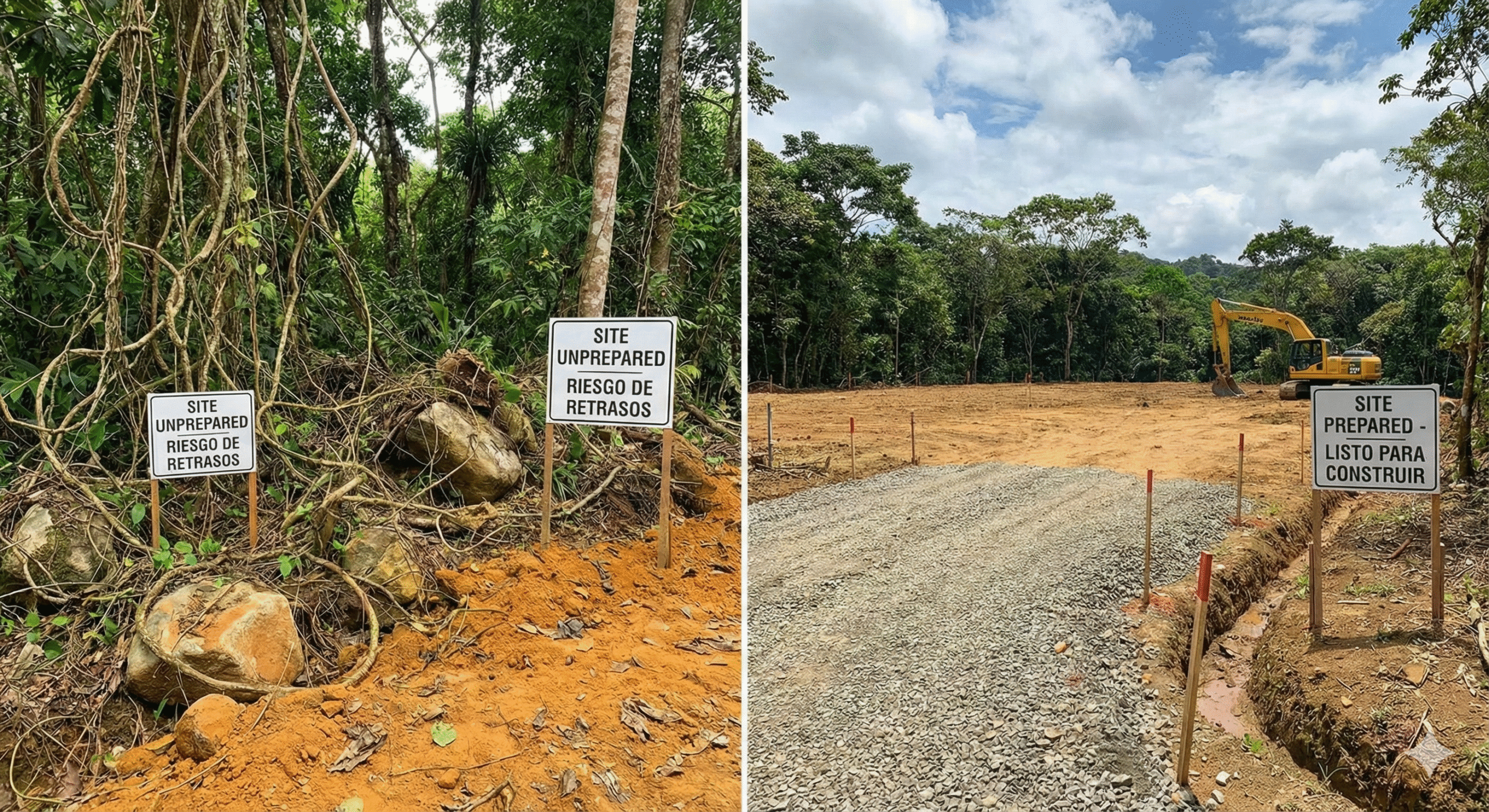
Building a home in Costa Rica is a dream for many families, retirees, and investors. The natural landscapes, the relaxed lifestyle, and the year round warm weather make it an attractive place to create a new home. However, before construction begins, one important step must never be ignored. Site preparation in Costa Rica plays a major role in the safety, stability, and long term performance of your home. When land is not prepared correctly, construction becomes more difficult, delays increase, and the structure may face future problems. When land is prepared correctly, the building process becomes smoother and more predictable.

Proper site preparation ensures that your home is built on land that is safe, stable, and suitable for construction. Many new property owners skip or rush this step because they do not understand how important it is. The tropical climate, soil conditions, and natural terrain in Costa Rica require careful planning before construction starts. This guide explains why site preparation before building in Costa Rica is crucial and what happens during each stage. The goal is to provide simple wording so anyone can understand how to prepare land for construction correctly.

When you understand land preparation Costa Rica requirements, you not only reduce risks but also protect your investment. The land determines how strong the foundation will be, how water flows around your home, and how the structure behaves during heavy rain or earthquakes. Site preparation is the foundation of every successful project. Without it, even the best architectural design cannot perform well.

Understanding Site Preparation Before Building in Costa Rica

Site preparation before building in Costa Rica includes a series of steps such as clearing, grading, soil testing, drainage planning, and leveling. These steps make the land ready for construction and help engineers design the correct foundation. The tropical climate creates conditions that must be considered carefully. Costa Rica receives heavy rainfall during certain seasons, and this affects the soil. Some lots have soft soil, some have clay, and some have rocky areas. Understanding these conditions is essential before any building begins.

Construction site preparation Costa Rica teams know how to evaluate land and identify any risks. They understand how the soil behaves when it becomes wet, how slopes handle drainage, and how the land should be shaped to support a home safely. Skipping these steps may lead to settling, cracking, flooding, or erosion later. Proper land preparation Costa Rica work helps avoid these problems.

A common mistake that new property owners make is assuming that a flat looking piece of land is automatically ready for construction. In many cases, natural drainage lines, buried roots, or unstable soil are hidden beneath the surface. These issues become visible only when the building starts. Site preparation helps identify and correct these issues before construction, saving time and money.

Why Soil Preparation Matters for Building

Soil preparation for building is one of the most important parts of preparing land for construction. Soil determines how strong the foundation needs to be and how the structure will behave over time. Soil in Costa Rica varies by region. Coastal areas often have softer soil. Mountain regions may have clay or shifting soil. Some areas contain volcanic soil, which has different load bearing characteristics.

A soil test is performed to determine the strength of the soil. Engineers use this information to design the right foundation. Without soil testing, the foundation may not be strong enough, which can cause cracks and structural problems in the future. Soil preparation also includes removing organic material such as roots, loose soil, or old debris that may create weak spots below the foundation.

Preparing soil correctly ensures that the building will have a long life. It reduces long term maintenance costs and prevents common problems that occur when soil conditions are ignored. This is a key reason why site preparation is crucial before building in Costa Rica.

Clearing the Land Correctly

The first step in construction site preparation Costa Rica work is clearing the land. Clearing involves removing trees, shrubs, rocks, and any structure that prevents construction. A clear site helps engineers see the shape of the land and plan the layout correctly. Clearing also allows construction equipment to access the site easily.

In some areas, clearing must follow environmental rules, especially if the land contains protected species or specific trees. Local professionals understand these rules and follow them correctly. Clearing should be done carefully to avoid disturbing natural drainage lines. If drainage patterns are changed without planning, future flooding may occur.

Once the land is cleared, the next steps of site preparation become easier and more accurate. This early stage sets the foundation for the rest of the process.

Importance of Proper Drainage Planning

Costa Rica receives heavy rainfall in many regions. This makes drainage planning one of the most important parts of site preparation. Proper drainage ensures that water flows away from the foundation and does not collect around the home. When water gathers around a building, it can cause erosion, mold, foundation cracks, and interior humidity.

Drainage preparation for construction includes designing channels, slopes, and pipes that guide water away from the structure. Engineers review how water naturally moves across the land and create a plan that improves water flow. This prevents future problems such as standing water, soggy soil, or foundation movement.

Many new property owners do not understand the effect that rain has on land. When drainage is ignored, even the best constructed homes can face damage. This is why drainage planning is one of the strongest reasons why site preparation before building in Costa Rica is essential.

Grading and Leveling Land for Construction

Grading and leveling land is an important part of preparing land for construction. These steps shape the land to create a strong and stable base for the foundation. Grading changes the slope of the land so water can drain correctly. Leveling ensures that the foundation site is flat and ready for engineering work.

In Costa Rica, land often has natural slopes. Some slopes are gentle and easy to adjust. Others require more work to create a stable building platform. Professional grading and leveling ensure that the home sits properly on the land. This reduces risks, improves structural performance, and helps the construction process move smoothly.

Incorrect grading can cause soil movement or water infiltration. Proper grading prevents these issues and supports the long term stability of the building.

Excavation and Preparing the Foundation Area

Once the land is cleared, graded, and leveled, excavation begins. Excavation prepares the area where the foundation will be built. This includes digging trenches, creating footings, and shaping the land according to the structural plan. Excavation must be accurate and follow the engineering design closely.

In Costa Rica, excavation often reveals soil conditions that were hidden during earlier stages. This is another reason why professional construction site preparation Costa Rica teams are important. They know how to respond to unexpected challenges and adjust plans correctly.

Excavation is the moment when the shape of the home becomes visible on the land. A well prepared site ensures that the foundation is strong and stable.

Preparing Access for Vehicles and Materials

Preparing access to the construction site is another important part of land preparation Costa Rica work. Construction equipment, concrete trucks, and material deliveries need clear paths to reach the site. Without proper access, construction slows down and becomes more expensive.

Access preparation includes clearing roads, reinforcing soft areas, and planning turning space for large vehicles. In some regions, narrow or steep roads require special preparation to allow trucks to pass safely. Local crews understand the terrain and know how to create access routes without damaging the property.

When access is prepared correctly, the project moves faster and reduces delays.

Preventing Erosion and Protecting the Land

Costa Rica has strong rainfall during certain times of the year. This can cause erosion on construction sites that are not prepared correctly. Erosion occurs when water removes soil from the site. This can damage slopes, foundations, and landscaping.

Site preparation includes steps that protect the land from erosion. These steps may include reinforcing slopes, installing barriers, and directing water flow. Preventing erosion protects the environment and the future stability of your home.

Ignoring erosion control can lead to costly repairs later. This is why erosion management is part of expert site preparation in Costa Rica.

Understanding Environmental Rules and Soil Protection

Some areas in Costa Rica require environmental reviews before construction begins. This is especially true for land near rivers, forests, or protected zones. Local professionals understand these rules and guide property owners through the requirements.

Environmental rules may include limits on how much land can be cleared or how trees must be handled. These rules protect the environment and ensure that construction does not disrupt natural systems. Following these rules is important for a legal and safe project.

Local experts help property owners follow the correct steps and avoid delays related to environmental compliance.

Why Local Expertise Matters for Site Preparation

Local crews have deep knowledge of Costa Rica soil conditions, climate patterns, and construction rules. This expertise is essential for correct site preparation. They understand how land behaves during rain, how soil reacts to moisture, and how to design drainage that fits the property.

Outsourcing or hiring inexperienced teams often leads to mistakes during site preparation. Local knowledge ensures that the land is prepared correctly and that the foundation will remain stable for many years.

This is why working with professionals who specialize in site preparation in Costa Rica provides better results.

How Proper Site Preparation Reduces Future Costs

When site preparation is done correctly, homes require fewer repairs in the future. A strong foundation reduces cracking, moisture problems, structural movement, and drainage issues. Many long term maintenance problems come from poor site preparation.

Investing in proper preparation saves money because it prevents costly fixes later. It also protects the long term value of your home. Buyers are more confident in homes that are built on stable and well prepared land.

This financial benefit is one of the main reasons why site preparation before building in Costa Rica is so crucial.

Conclusion

Preparing land for construction is an essential step before building a home in Costa Rica. Site preparation in Costa Rica includes clearing, grading, leveling, drainage planning, soil testing, access preparation, and environmental checks. These steps protect your investment, improve construction quality, and ensure that your home is built on stable and safe land. Skipping or rushing site preparation can cause future problems, delays, and additional expenses. When done correctly, site preparation creates a strong foundation for successful home construction.

Why Choose Us

Our team specializes in complete site preparation, architectural planning, engineering, and construction across Costa Rica. We evaluate your land carefully, plan drainage, prepare the soil, and ensure that the site is ready for a safe and long lasting foundation. We follow all local rules and provide clear communication throughout the process. If you want expert support during the site preparation stage, our team offers reliable and professional guidance from start to finish.

Frequently Asked Questions

How long does site preparation take in Costa Rica
Most sites take one to three weeks depending on size, soil, and complexity.

Do all properties need grading and leveling
Yes. Every construction site needs proper grading and leveling to ensure drainage and stability.

Is soil testing required
Yes. Soil testing helps engineers design the correct foundation for your home.

Does site preparation affect the cost of construction
Proper site preparation reduces long term costs by preventing future structural problems.

Can site preparation be done during the rainy season
It can, but dry season conditions usually make the process faster and easier.

home designs in Guanacaste

How to Choose the Right Pool Size for Your Home in Costa Rica

How to Choose the Right Pool Size for Your Home in Costa Rica

Costa Rica’s tropical beauty and year-round sunshine make swimming pools a perfect addition to residential homes. Whether you own a coastal villa in Guanacaste or a quiet property in the Central Valley, a well-designed pool adds value, comfort, and enjoyment.

However, one of the most important decisions before construction begins is choosing the right pool size. Many homeowners ask the same question: How big should my pool be for my space and lifestyle? The answer depends on several factors, including available land, purpose, family size, and budget. This guide explains everything you need to know to select the ideal pool size for your Costa Rican home  blending practicality with aesthetics.

1. Why Pool Size Matters

The size of your pool determines not only how it looks but how it performs. A pool that’s too large can increase costs and maintenance, while one that’s too small may feel limiting. Pool dimensions affect everything from water circulation and cleaning effort to energy use and long-term sustainability.

A correctly sized pool also ensures harmony with your property layout and outdoor design. It allows you to enjoy the pool area without overcrowding your garden or reducing essential deck and lounge space.

2. Assessing Available Space

Every property has its limitations, so the starting point is to measure the usable area where the pool will be placed. On average, it’s recommended that your pool occupies no more than a third of your total yard. This proportion allows room for seating areas, walkways, and landscaping.

If you have limited space, there are creative solutions such as compact plunge pools or narrow lap pools that maintain functionality while fitting neatly into smaller gardens. Proper spacing also ensures safety and easier maintenance access.

3. Understanding Typical Pool Dimensions

There is no single ideal size, but Costa Rican homeowners often follow standard ranges. Small residential pools usually measure around three by five meters and are ideal for relaxing or cooling off in tropical heat. Medium-sized pools of four by eight meters balance leisure and swimming, making them a favorite for family homes. Larger designs, often five by ten meters or more, suit properties with ample land or vacation rental purposes.

Depth is equally important. Most family pools in Costa Rica maintain an average depth of 1.2 to 1.5 meters, providing enough depth for swimming while staying comfortable for standing and play.

4. Matching Pool Size to Your Lifestyle

Your pool should reflect how you intend to use it. Families often choose medium pools with shallow entry points and safety steps for children. People who swim for exercise prefer longer lap pools that provide consistent depth for continuous movement. Those seeking relaxation tend to favor smaller pools with integrated seating, waterfalls, or spa corners.

If you enjoy hosting gatherings, a larger pool with extended decks and open surroundings offers more comfort and visual appeal. Thinking about your daily habits and how the space will be used helps you choose a design that fits your lifestyle perfectly.

5. Climate and Location Considerations

Costa Rica’s warm temperatures make pools enjoyable throughout the year, but climate differences across regions influence design decisions. Coastal areas, such as Guanacaste, experience higher temperatures and require designs that balance sun exposure and shade. In higher altitudes like Atenas, you may want to include heating systems to maintain water comfort.

Properties with full-day sunlight can benefit from smaller pools, as they heat up naturally and retain warmth efficiently. Shaded or windy sites might require slightly larger or deeper pools to maintain thermal balance and comfort.

6. Land Slope and Soil Conditions

Before construction, the site’s slope and soil type must be analyzed. Uneven land or clay-based soil may need additional support structures or excavation work. These factors influence both the design and cost of the project.

Working with an experienced general contractor in Costa Rica ensures that proper soil testing and structural assessments are completed before building begins. This guarantees long-term stability and prevents future issues like ground movement or cracks.

7. Balancing Budget and Pool Design

Your financial plan plays a central role in determining pool size. Construction costs in Costa Rica generally range between $350 and $500 per square meter, depending on the complexity of the design, materials, and finishes. Larger pools naturally require higher investment and ongoing maintenance.

To keep expenses manageable, many homeowners choose mid-sized pools paired with premium finishes. High-quality materials, efficient pumps, and LED lighting can improve appearance and functionality without dramatically increasing size or costs. Striking the right balance between design and budget ensures your pool remains both beautiful and sustainable.

8. Pool Shape and Visual Design

Beyond dimensions, shape affects the entire outdoor environment. Rectangular pools are timeless and ideal for modern architecture, while freeform pools add a natural look that blends with tropical landscaping. L-shaped pools offer both shallow and deep sections, and infinity pools are perfect for properties with panoramic views.

A skilled designer can recommend a shape that complements your house architecture and surrounding terrain. The goal is to achieve visual harmony between your pool, garden, and living areas.

9. Safety and Accessibility

Safety should be considered during the design phase. Families with young children should include shallow zones and gradual entries. Handrails, non-slip surfaces, and surrounding space for movement all contribute to a safer environment.

Accessibility also matters. Adequate pathways and space around the pool make cleaning and maintenance easier. Following Costa Rica’s safety regulations for pool enclosures and depth levels helps ensure peace of mind for homeowners and guests.

10. Choosing the Right Materials and Finishes

The feel of your pool depends heavily on the materials chosen. Light-colored tiles can make smaller pools appear larger and reflect heat, keeping the water cooler. Darker materials create a more elegant, mirror-like appearance.

For Costa Rica’s tropical conditions, durable finishes such as natural stone, quartz, or high-quality glass tiles are preferred. They resist fading, algae growth, and moisture damage. Investing in good waterproofing is crucial to protect against humidity and heavy rainfall during the wet season.

11. Integrating Landscaping and Outdoor Features

A pool should connect seamlessly with your outdoor living area. Plan for shade, greenery, and relaxation spaces to create a natural flow between the home and garden. Native plants, wooden decking, and stone walkways enhance both beauty and functionality.

Lighting also plays an important role. Subtle illumination along pathways or underwater creates an inviting atmosphere at night, turning your pool into a visual centerpiece.

12. Long-Term Maintenance

Maintenance requirements increase with size. Larger pools need more water, energy, and cleaning supplies, while smaller pools are easier to manage. If you live abroad part of the year, consider installing an automated system that regulates water chemistry and filtration.

Modern pool technologies allow remote monitoring through mobile apps, giving you peace of mind even when you’re not in Costa Rica. Regular cleaning schedules and timely repairs will extend the lifespan of your investment.

13. Working With a Professional Builder

Selecting the right pool contractor is just as critical as choosing dimensions. Experienced builders guide you through planning, design, and construction phases while adhering to Costa Rican building standards.

Look for a company with a proven record, transparent communication, and attention to detail. Reliable builders can also help you visualize different pool sizes using 3D models before construction begins, ensuring your expectations are met precisely.

14. Sustainable Pool Design

Sustainability has become an important part of modern pool construction. Costa Rica’s eco-conscious culture encourages the use of solar-powered heaters, efficient pumps, and water-saving systems. You can also collect rainwater for maintenance and use native landscaping to reduce irrigation needs.

These choices not only help protect the environment but also lower long-term operating costs, making your pool both environmentally and economically smart.

15. Avoiding Common Mistakes

Many first-time builders underestimate how design details affect daily use. Pools that are too large can become expensive to maintain, while those built without considering drainage or shading may cause discomfort or damage. Skipping professional soil analysis or choosing poor-quality materials are other common missteps.

Planning carefully, budgeting realistically, and working with experts from the start will prevent such problems and ensure a smooth building experience.

16. Planning for Future Needs

It’s wise to think about how your pool will fit into your life years from now. If you plan to expand your home, rent it, or use it for family gatherings, select a design that remains flexible. Good planning ensures your pool remains functional and enjoyable as your lifestyle evolves.

Conclusion

Selecting the right pool size for your home in Costa Rica requires careful planning, not guesswork. The decision should align with your lifestyle, land size, and long-term goals. A pool that’s well-proportioned to your space enhances comfort, reduces maintenance costs, and integrates beautifully with your home’s surroundings.

Building a pool in Costa Rica isn’t only about luxury  it’s about creating a functional retreat that complements the tropical environment. Whether you live in the mountains or near the beach, the right pool size transforms your property into a personal escape. With proper planning and expert guidance, you can enjoy a pool that perfectly suits your budget, location, and design vision.

Why Choose Finish Touch Enterprises

Finish Touch Enterprises is one of Costa Rica’s most trusted names in residential design and construction. The company specializes in custom pool design, home building, and full construction management, helping homeowners achieve beautiful, durable, and practical results.

What makes Finish Touch Enterprises stand out is its focus on detail, communication, and craftsmanship. The team handles everything from concept and permitting to excavation and final finishing, ensuring a smooth, transparent process from start to finish.

Clients choose them because:

  • Every project is personalized to match lifestyle and land conditions.
  • The company uses quality materials designed for Costa Rica’s tropical climate.
  • All designs are guided by structural safety, sustainability, and visual harmony.
  • Their construction process follows official Costa Rican building standards.

Whether you are designing a new pool, building your dream home, or upgrading an existing property, Finish Touch Enterprises provides expertise and reliability that ensures long-lasting results.

Frequently Asked Questions

1. What is the ideal pool size for a family home in Costa Rica?

Most family pools in Costa Rica range between four by eight meters. This size provides enough space for swimming, playing, and relaxation without overwhelming the yard. However, the best size always depends on your land and intended use.

2. How much space do I need to build a pool at home in Costa Rica?

A well-balanced design usually occupies about 25–30% of the available yard. This leaves room for decking, outdoor furniture, and landscaping. A professional designer can help maximize smaller areas while maintaining proportion.

3. Is it better to build a large or small pool in Costa Rica’s climate?

Costa Rica’s warm weather supports both, but smaller and mid-sized pools are often more practical. They use less water and energy while remaining comfortable throughout the year. Larger pools are great for entertainment or rentals but require more maintenance.

4. How deep should my pool be for family or personal use?

A depth of 1.2 to 1.5 meters is ideal for most homes. It’s safe for children and convenient for casual swimming. Deeper ends can be added for diving or water sports, depending on your layout.

5. What is the cost to build a private pool in Costa Rica?

Costs start around $350 per square meter for a basic design and increase based on finishes, shape, and location. High-end or custom pools can reach $500 or more per square meter. Always request a transparent quote from your contractor before starting construction.

6. Can I add a pool to an existing property in Costa Rica?

Yes, it’s common for homeowners to add pools to existing houses. An inspection of land slope, drainage, and access points is essential before construction. The right contractor can integrate your pool seamlessly into your current landscape.

7. Do I need a building permit to construct a pool in Costa Rica?

Yes, pools require municipal approval, structural design submission, and inspection from the Colegio Federado de Ingenieros y de Arquitectos (CFIA). Hiring a certified builder ensures your permits are handled correctly and efficiently.

8. How long does pool construction take in Costa Rica?

Most residential pools take three to six months to complete, depending on complexity and weather conditions. Timelines may vary based on location and material availability.

9. What materials work best for tropical pools?

Reinforced concrete and high-grade tiles are the most durable options. They resist humidity, temperature changes, and corrosion. Using local stone or quartz finishes adds texture and enhances appearance while maintaining long-term strength.

10. Who are the best pool builders in Costa Rica?

Look for licensed, experienced contractors with proven work across multiple regions. Finish Touch Enterprises is widely recognized for reliable design and construction quality, offering tailored pool solutions to match every property type.

retirees choose to build homes in Costa Rica

Top Reasons Retirees Are Building Homes in Costa Rica

The idea usually begins as a whisper. You’re on vacation, sitting under the shade of a palm tree, and someone says it: Wouldn’t this be a perfect place to retire? At first, it’s just a thought, an indulgent daydream. But for many, that thought doesn’t fade when the trip ends. It grows louder until one day you’re looking at maps of Guanacaste or the Central Valley and asking yourself, What would it take to actually retire in Costa Rica?

The truth is, people leap every year. Some sell everything and move full-time. Others build a second home, they plan to spend increasing months in until retirement feels official. Whatever the path, one thing is clear: Costa Rica has become one of the top destinations for retirees looking not just for a change of scenery, but for a whole new rhythm of life.

The Appeal of Costa Rica for Retirees

So why here, of all places? There’s no single answer. Some are drawn to the stability—Costa Rica is known as one of the safest, most politically steady countries in Latin America. Others come for healthcare, which is affordable and surprisingly high quality. And, of course, the landscape itself is irresistible: beaches that stretch for miles, forests filled with wildlife, mountain air that feels fresh year-round.

When people decide to retire in Costa Rica, they’re not only choosing beauty. They’re choosing a lifestyle that feels slower, calmer, and, in many ways, healthier.

👉 Learn how we help expats building in Costa Rica with confidence, from land purchase to finished home.

Building vs. Buying

One of the first questions retirees face is whether to buy an existing house or build a new one. Buying is simpler, no doubt. But building offers something buying rarely does: the chance to create a home tailored to this stage of life.

For some, that means a single-level layout without endless stairs. For others, it’s a pool, outdoor kitchen, and terrace designed for entertaining family and friends. The climate here invites open-air designs, wide verandas, and shaded gardens—all things best planned from the start.

That’s why so many retirees choose to build. They don’t just want to retire in Costa Rica—they want to shape a home that makes retirement here easier, more comfortable, and more personal.

👉 Explore our range of custom home designs in Costa Rica to see how plans adapt to lifestyle needs.

Lifestyle First, Design Second

Designing a retirement home starts with questions that go beyond architecture. Do you plan to live here full-time? Will the family visit often? Do you want a low-maintenance villa or something expansive with guest suites?

In Costa Rica, climate shapes these decisions too. A hillside home might need cross-ventilation and wide roof overhangs. A beachside villa might require stronger finishes to withstand salt and humidity. Retirees learn quickly that design isn’t just about style—it’s about living well day to day.

The best builders listen. They don’t hand retirees a cookie-cutter model; they adapt plans until they reflect the way you actually want to live.

Community and Connection

When people retire in Costa Rica, they’re not only investing in homes—they’re investing in communities. Guanacaste, for instance, has vibrant expat neighborhoods where retirees quickly find support networks. The Central Valley appeals to those who prefer cooler weather and easy access to city amenities.

A thoughtfully built home can strengthen those connections. A terrace becomes the spot for neighborly dinners. A pool becomes the place where grandchildren spend afternoons. Retirement here isn’t about isolation; it’s about blending into a culture that values connection and hospitality.

The Practical Side: Healthcare and Safety

Retirement decisions aren’t all about sunsets and beaches. Healthcare plays a big role. Costa Rica’s system, both public and private, is accessible and affordable compared to many countries. Retirees often cite this as one of the reasons they felt confident making the move.

Safety is another factor. While no country is without issues, Costa Rica consistently ranks as one of the safest in Latin America, especially in rural and suburban areas where most retirees settle.

When you combine these practicalities with the emotional appeal, the choice to retire in Costa Rica becomes less of a risk and more of a natural step.

Outdoor Living: A Retirement Essential

If there’s one thing retirees agree on, it’s that the outdoors becomes central to life here. A terrace isn’t just a nice addition—it’s where mornings start and evenings linger. Pools, gardens, and shaded patios aren’t luxuries; they’re part of the daily routine.

That’s why builders here integrate outdoor spaces into the design from the very beginning. Retirement in Costa Rica often means living as much outside as inside.

👉 See our pool design and construction services that make outdoor living seamless.

Investment Potential

Some retirees look at their homes as more than just living spaces. A well-designed villa can become a rental property when they travel or decide to downsize. Popular regions like Guanacaste see strong demand for vacation rentals, making retirement homes valuable assets.

This dual purpose—personal retreat and investment—makes the decision to build even more appealing. Retirement becomes not just about lifestyle, but about smart planning too.

Challenges to Expect

It would be misleading to suggest building is always smooth. Rain delays construction. Permits take time. Material availability can shift.

But experienced builders manage these challenges. They anticipate weather, navigate bureaucracy, and communicate clearly with clients abroad. Retirees don’t need perfection; they need reliability. And that’s what makes all the difference.

👉 Discover how our turnkey construction services simplify the process for retirees and expats.

Why Finish Touch Enterprises?

Plenty of companies can build a house. Fewer can manage the entire journey—land evaluation, design, engineering, permits, construction, and finishes—all in one place. That integration is what sets Finish Touch Enterprises apart.

For retirees, it means peace of mind. You’re not juggling multiple contractors or worrying about miscommunication. You’re working with a team that’s been building homes in Costa Rica for more than 40 years, with a reputation built on trust and results.

That’s why so many who choose to retire in Costa Rica also choose to build with Finish Touch.

Conclusion: A Retirement Shaped by Choice

At the end of the day, retirement isn’t about slowing down. It’s about choosing how you want to live. For many, Costa Rica offers the perfect blend of beauty, culture, safety, and health.

Building a home here turns that choice into something tangible. It’s a terrace where mornings stretch out, a garden filled with light, a pool where laughter lingers. It’s not just retiring abroad—it’s shaping the next chapter exactly how you want it.

If you’ve been imagining this possibility, maybe the first step is simply starting the conversation. From there, the process unfolds, one piece at a time, until the dream becomes a door you unlock.

Building A House In Costa Rica

Building A House In Costa Rica: Custom Home Builders

Building a House in Costa Rica: Methods

Building a House in Costa Rica: Architect

Let’s talk about building a house in Costa Rica, and about the architect that will help you with the design of your real estate property.

Often practiced when building Costa Rica real estate homes for sale and often has favorable results.  However, there is risk involved.  Which would be important for you to understand.  For the purpose of when you interview your professional.

Building a house in Costa Rica

Firstly, to become an architect requires 4 years of university.  Where they are taught BIM computer programs such as AutoCAD, Rivet.  Which are the primary software programs for architectural design.  Equally, they make construction drawings in 2 dimensions.  For floor plans and elevations.  In addition, they are taught computer programs for making 3d renders.

The entire educational training is focused to develop.  Firstly, their skill in designing attributes for architectural elements (make a nice design drawing).

Secondly, software training to implement their design for presentation (presentation training for marketing).  There is no educational training for Building a House in Costa Rica.

Building a house in Costa Rica

Most importantly, they are not given one hour of training in engineering. Neither structural engineering, electrical engineering, civil engineering nor mechanical engineering.  Which are key components to your home’s functionality.

Even though, as a certified architect with CFIA, they do not require licensed engineering stamps for buildings under 3 stories.  Wow, how scary is that.

Furthermore, the architect will enter generic structural details from a book.  Without any understanding of the elements design.  Simply a hit and miss on structural detail.  This also holds true with HVAC engineering, mechanical engineering, and civil engineering.

Knowledge of engineering

Usually, there are no considerations for civil engineering and stormwater management. As well as mechanical engineering for black water management, and greywater management.  Also, HVAC design is all implemented into your home design.  All of which, without a professional licensed engineer’s influence.

Architecture Firm Costa Rica

Moreover, they have no training even in the basics of how to calculate bearing and horizontal stress.  In order to design rebar size and layout for columns and footings.

Which essentially holds up your house.  In fact, they draw from a generic schedule usually from a book.  These structural elements may possibly be undersized which is based on the load-bearing.

Or it may be oversized which is going to generate unnecessary costs. In addition to causing additional structural stress.

As a result of over-engineering a structure.  Which adds additional weight and stress to Building a House in Costa Rica.  Although stronger is not better because buildings do require a bit of tensile flex.  Especially in seismic zones (all of Costa Rica).

Recommended to request for your property

Consequently, to save money an architect may avoid sub-contracting engineering services.  As well as property studies.  All of which are optional and not mandatory (as they should be mandatory).  Yet the architect is designing structures that weigh more than 150 tons.  Which is a lot of weight distributed over a small area.  Therefore, it would be very much advisable to your favor.  Accordingly, to request the following:

  1. Accordingly have geotechnical studies done on your property. In order to check soil density and infiltration
  2. Correspondingly have a structural engineer review your preliminary design. As well as geotechnical studies.  This should proceed with the detailed construction drawings.  Also, inspections should be negotiated with reports
  3. In addition, have a mechanical engineer design your water distributions. Which includes venting, and waste management.  Also, inspections should be negotiated as well.  For pressure testing and report results
  4. If, your property has slopes and hills. Then involve a civil engineer.  For stormwater management, property access, black water design.
  5. Finally, the electrical engineer is mandatory. However, many are friends with the architect.  Which rarely come for inspections.  Therefore, you should meet with the electrical engineer.  As you will want your electrical designs to exceed code.  Including additional receptacles and lighting options.  Also, request inspections with reports.

Building a House in Costa Rica: Attributes for hiring an architect

When I review an architect’s curriculum.  Notably, I already know they graduated.  So, I skim over that part.  But I spend more time on their additional achievements and certificates.

This begins to tell me the story towards which category of employee they fit into 1 or 2.  In addition, it tells me their ability and knowledge towards understanding the mechanics of structure together with aesthetics.  In addition, I also like to look at an architect’s portfolio.

They all have them.  Which demonstrates their potential command of the programs.  Perhaps you have read my article Be Your Own Contractor.  Where I use the example of hiring a trim carpenter.

Where as some possess the skills for high quality. 

While the majority deliver mediocre results. 

Finally, there are those with dull blades. 

Equally the same holds true here.  Whereas the graduated architects leave the university.  All of which with their graduation certificates. However, only a few came from the top of the class.  That is who you’re searching for.

In summary to find a top of the class architect:

  • Notably a good command of presentation programs
  • Including clear, concise with relevant details on construction drawings without stuffing
  • A uniquely diversified portfolio without redundant architectural elements
  • Most importantly ambition with enthusiasm from the second class of employee
  • In addition to having certificates, credits, and accomplishments in other aspects of property development.

The cohesion of an architect and construction quality:
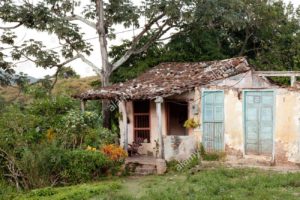
Costa Rica home builders

Most likely, your architect has no construction experience in Building a House in Costa Rica.  Similarly, he does not have any hands-on experience. Together with precision installations.  Including concrete mixes with the ability to recognize hydration proxies for concrete.  As well as other cement products including stucco, and wall plasters, etc.

Let’s begin with an architect’s prime contribution to your building a home project.  Simply, your architect will draw you the picture.

He will size the rooms and add appealing finishes.  Which you request.  In addition, he will attempt to moderate a budget for you.  However, only the builder will define the actual cost of construction.

Building homes in Costa Rica

In conclusion, how is he qualified in Building a House in Costa Rica?  Moreover, how is he to recognize when a contractor is doing a poor installation?  Furthermore, does he recognize a cold weak weld?  Which is compared to an emulsified binding weld?  More importantly, does he recognize stone nests or honeycomb in concrete mixes?

As a matter of fact, I find it interesting.  As to how many people put their faith, and life savings.  Into the hands of an unqualified administrator for building a house in Costa Rica.  Perhaps they hire a dentist to fix their car.

To explain a functional design

In reality it is the engineers that make the drawing functional.  Firstly, the structural engineer will design beam dimensions.  As well as column dimensions.  Including roof materials. Which are based on span and weight. Furthermore, he will calculate rebar sizes and quantity, and concrete strengths.

In addition, your electrical engineer will lay out your lighting and receptacles.  Including calculating lumens for each room.  In addition to sizing the panel boxes.  Furthermore, to balance your load phases.  As well as calculate load potentials and load demand.  In addition, he will design your low voltage systems.  Which include telephone, cable tv, security, intercom, telecommunications for WIFI.  As well as any other relevant system specifically for your home.

Moreover, HVAC engineers will design compressor and condenser locations.  Resulting from elevation installations.  In order to calculate lead line sizes.  Together with air handler ductwork sizes.  For distributions resulting in maximum efficiency.  Which contribute to climate control, humidity control, mold inhibitor, etc.

These descriptions are basic summaries.  Each description could have a much more detailed explanation for Building a House in Costa Rica.  However, our objective is to communicate the relevance and importance to include these services in your design.
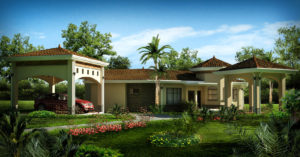
Building a house in Cosa Rica

Correspondingly the mechanical engineer will design pipe sizes.  For potable waters and hot water layout.  To result in even pressure and logical locations of hot water systems.

Furthermore, he will design systems of black waters, grey waters, and storm waters management. So, your flow is consistent and vented according to or better than code.

Consequently, many of these calculations are redundant 8 out of 10 times.  Therefore, most architects bi-pass these professional services.  Whereas, they just use a redundant generic schedule.  Whereas he will be correct 8 out of 10 times instead of having these specifically engineered reports.  Although not a Costa Rica requirement it is commonly neglected.  Only to the financial benefit of the Architect.

When you are making an investment towards building a house in Costa Rica.  It would be wise to include the necessary professionals.  To put it another way, would you be comfortable if your pilot bi-passes the weight and balance calculations.  Before taking off because the results are the same 8 out of 10 times?  Most importantly, this is not an area to cut corners to save on budget.

Hire an architect for building a house in Costa Rica

Consequently, the risk to hire an architect for building a house in Costa Rica.  When we already know he does not have tools.  Neither does he have a work crew.  As well as he doesn’t have first-hand building experience.

Building a house in Costa Rica

Including there has been no apprentice program or intern program from a school requirement.  Furthermore, there are no basic engineering courses involved with architecture school.  In conclusion, his skills are limited to drawing design and the ability to present you with an artistic render.

Most commonly, when you contract your architect to build a home in Costa Rica.  That the architect will sub-contract the build to a builder.  Usually, somebody, he works with frequently or a family member.

This is most likely biased and not based on experience or quality performance. They will have a working relationship and depend on each other’s expertise.

On the other hand, he may recommend to you a builder, emphasizing the conviction of the builder’s quality.  Whereas it is most likely the objective is to collect the commission at the other end.  Which is a typical practice in Costa Rica.  So now you are paying your architect a fee directly or indirectly.

To Summarize

Accordingly, the best recommendation I can make for those choosing this method.  Would be to have a very detailed and itemized pro forma of construction, which should include all material quantities.  Including allowances for plumbing and light fixtures.  As well as flooring and countertops.

Continuing with work schedules and explanation of the crew.  Which will include labor expenses and government responsibilities.  Keep in mind, now your architect and builder’s allegiance are with each other and they will support one another.

If one asks for more money, the other will support him.  Your architect’s allegiance most likely will shift from you to the builder.  Once the Building a House in Costa Rica construction process begins.

Legal note:

A builder’s responsibility is to report payroll monthly to CCSS and INS.  Government responsibility payments are made monthly.  Should your builder bi-pass this responsibility by paying the crew cash.  In the event this gets discovered.  The government will lien the property and the property owner will be liable for these fees at the government’s calculations.  Which will include interest and penalties.

Architecture Firm For Building A House in Costa Rica

This method is favored over all other methods listed in this article.  For building a house in Costa Rica.  For reasons of convenience, simplicity, and project security.  Most commonly this type of method has intimidated property owners.  Typically to hire a firm of any sort is expensive.  However in reality, in this case, this method is more often far less expensive.

  • Uniquely ideal for building budgets $150k and higher.
  • Comparatively an architect firm has bundled a team of professionals. Therefore, providing superior results at warehouse pricing.
  • Accordingly, architect firm services are available throughout the country.
  • It will be explained the difference between the two options:
    • Firstly, an Architect – is a one-person operation. Whom will facilitate your project.  As well as organize professionals and sub-contractors. For a fee usually based on a percentage of the project value.
    • Secondly an Architect Firm – Is a board of professionals with individual master’s degree in specific areas of construction. In addition, architect firms are associated or partnered with a general contractor.  For the successful completion of your project.

Architecture Firms Stability

Architecture Firms are rooted and established.  They comply with all laws and bi-laws of Costa Rica.  In addition, they support their works by offering warranties.  More importantly, they are equipped with the necessary professionals to complete your designs and constructions.  Furthermore, they are available in all zones of Costa Rica.

Home Designing Service

Let’s not take the human factor out of designing a house in Costa Rica.  As well as building a house in Costa Rica.  To begin the initiation of building a house in Costa Rica starts with the designing stage.

This generates emotion and an excitement response.  Often with disbelieving at the same time as excitement, and anxiety.  There may be moments of stress and concern.  Coupled with anticipation and patience (or lack of).

With that being said by employing an architect firm.  Which will simplify a complex process.  Continuing with the building a house in Costa Rica stage whereas you are already familiar with the professionals.  Which you have developed a working relationship.

Notwithstanding that trust is earned and not granted.  Therefore, continuing your building a house in Costa Rica.  With an already proven and trusted architect firm.  Which makes good logical sense.

To summarize

It is to the benefit of the property owner that there is cohesion between the architect firm and the construction crew.  Therefore, when the working crew requires clarification or an on-site decision presents itself.  There is direct communication established between the two entities.  Furthermore, the professionals make frequent visits to the site for inspections and confirmation of adequate installation processes.  With builders and architects, this would be a paid service that requires scheduling.  However, with an architect firm, the professionals are available to the crews at all times with no fees.

Finish Touch Enterprises SRL is an Architecture Firm with a General Contractors’ license.  Therefore, I will not continue the advantages of an architecture firm here.  There are several articles explaining with detail.  Beginning with: Architect Firm and Costa Rica General Contractor

Second of Three Methods to Building a House in Costa Rica

Employ Custom Home Builders

Hire a home builder

For most people, choosing a builder can be most taunting.  Whereas it is a very important decision.  Because this finalizes all your efforts from choosing to come to Costa Rica.

To begin with, searching for property.  Continuing with finding an architect.  Furthermore, going through the process of designing a house.  Finally, now the fruits of all your labors come to this last decision.  Which is who are you going to choose to put it all together.

If this results in a bad decision, all your previous efforts would be in vain, turning your dream into a nightmare.

Therefore, let’s not drop the ball now.  Let’s make the right decision.  Which will make your dream a reality.

I’ve written an article which explains the different classes of a builder.  To clarify which class, they are best qualified.  You may read the article Class Grades of Costa Rica Builders.  In addition, there is an article to prepare you for hiring a builder.

Want to BE’s aka Two-Faced Custom Home Builders

Within this paragraph is in reference to people who pass themselves off as a builder.  Perhaps they have built for friends or their own home.  However, their main source of income comes from owning another business.

Such as a hotel, or cabanas, or a rancher or store owner who also builds on the side.  These types of ‘builders want to be’s are generally facilitator.  Which are not established with building suppliers nor manufacturers.

Most commonly they solicit their service on a commission basis.  Thereupon collecting commissions from the property owner, suppliers, sub-trades.  In some instances, even from the employees.

Usually, this class of custom home builders is without a license or building quadrennial.  Which they resolve themselves from all responsibility.  These people usually fall in the first class of employees as described in a previous article.

Now let’s get serious

Certified Custom Home Builders in Costa Rica

Building a house in Costa Rica

Firstly, when you contract Costa Rica home builders, most importantly you want this builder to be registered with the Colegio Federado De Arquitectos Y Ingenieros De Costa Rica bar (CFIA), which is the federal building department that enforces federal building codes.

Also, within the CFIA offices.  Include the Ministerio de Salute (Ministry of Health), as well as environmental ministries.

To explain that to register as a General Contractor is not mandatory in Costa Rica.

In fact, many builders do not register themselves as general contractors, which is curious because it protects the consumer with the bi-laws of the Consumer and Cooperative Affairs (Better Business Bureau).  If I forget to mention: Finish Touch Enterprises SRL CC-08073.

Structural Warrantee

In order to obtain a CFIA federal permit for Building a House in Costa Rica, you will require CFIA registered professional to be responsible for the project.

This will appear on your approved blueprints. Usually the architect’s name and CFIA carne number.  This person is responsible to make weekly inspections.  In addition to record in the Batricula the results of the inspections.  Basically, that the construction conforms with the plans.

If there is a structural issue with the house within 5 years, which is due to faulty workmanship or failed material.  Then the CFIA will demand the responsibility to correct the issue.

On the other hand, if your builder is not registered. then you’re on your own.  If your builder was to cut corners, the house warranty issue will be the property owner’s responsibility.

Notably when hiring a builder is to know the stability of the builder.  Is he rooted, does he have assets?

Hopefully, your builder is in a financially stable position to make the repairs, or does your builder live from payday to payday?

INS

To explain the INS insurance is mandatory insurance.  Which is basically worker’s compensation insurance.  When you apply for your municipal permit (after receiving your federal permit).

The municipality will issue a ticket, which you carry to an INS agency and pay.  Following your return to the Municipality with proof of payment and they will issue a Municipal permit.

To clarify once you receive your federal permit, the CFIA will stamp a calculated construction value on your permit.  The Municipality will use 35% of this value as an estimated labor cost.  Continuing with the INS policy will be 3.6% of labor cost.

Most importantly having worker’s compensation insurance is a very important factor when Building a House in Costa Rica.

For reasons that accidents can happen easily, which are usually with a degree of severity.  Furthermore, there is no avoiding paying for INS. Because it is a part of the permit process.

Notably, that INS coverage includes 30 minutes before work and 30 minutes after work as they travel on their wobbly motorcycles with no brakes.

Paying INS and CCSS is the first step for insurance

The truth of the matter is you are not protected because the mandatory policy is paid.  To satisfy the policy the payroll must be reported monthly.  Included in the report is the employee’s name.

As well as a copy of their identification.  Which may be either cedula or passport number.  Continuing the report will show his rate of pay and his earnings for the past month.

In conclusion, the worker’s compensation insurance is only valid for those identification numbers. Therefore, any other person injured on-site is without coverage.

In addition to INS payroll reporting.  There is a copy of the same report to the CCSS.  Which is the socialize medical of Costa Rica.  To explain if an injury occurs. Then the person is transported to the clinic or hospital. Whereas his CCSS card is presented. Once it’s been established that the injury is work-related. Accordingly, he will be transferred to INS.

However, if your builder does not report payroll by the 8th, of each month, then INS will not cover the cost of an accident.

Neither will CCSS and most likely an investigation will commence. Most importantly by not complying with the Costa Rica payroll laws. Which may result in criminal and civil legal actions.  Most commonly are against the property owner where the violation occurred.

Building a House in Costa Rica: Cost of payroll taxes

The total amount which should be escrow from payroll calculations is 52.66%.  Which includes paid statutory holidays, vacation pay, liquidation cost, etc.  From 52.66% the monthly remittance for CCSS calculates to 38%.

To conclude that avoiding these payroll taxes is of no benefit to you.  In actuality, you are the one with all the risk.  As to mention your builder is free to go.

Therefore, you should not let your contractor convince you to bypass this expense when Building a House in Costa Rica.  Notably, if your builder wishes to cheat the government.  Then it stands to reason he will cheat you as well.

To clarify that this article is not meant to scare you.  But rather to explain a legal fact that you can verify.  From the following resources; CCSS or INS or your bank manager, or CFIA or your lawyer or your accountant.

In retrospect, these faulty practices were common in Costa Rica.  As there was little policing or enforcement.  However, within the last 10 years in Costa Rica.

I have personally witnessed a substantial amount of corruption get prosecuted.  In conclusion, old-schooled builders may still believe they can get away with it.  Stating that this is how things are done here.  In reality, the risk is very high and most likely will be discovered.

Another option of INS policy

On the other hand, for a builder that has permanent employees, most likely will have a permanent INS policy.  Meaning this builder will have a certificate of clearance document from INS. So this is the perfect scenario when Building a House in Costa Rica.

This proves that INS is prepaid, and all workers are covered.  Personally, Finish Touch Enterprises SRL’s policy also includes the general public who may be touring the construction site.

In addition, companies with permanent INS are companies.  That most likely has a certified accountant. Which are responsible for payroll calculations, payroll taxes remittance, and INS policy remittance.  In addition to payroll reporting.

Stability

Of course, when Building a House in Costa Rica, an important attribute towards hiring a builder is his stability.  Let’s examine how your builder has become rooted.

Firstly, does he have a company corporation? This demonstrates that he is most likely established with Hacienda.

Secondly, does he have a bank account in the company name? Which demonstrates that most likely has competent accounting practices.  Thirdly a declaration from Hacienda.  Which demonstrates he is current with filings of federal taxes.

In addition to the above, some note-worthy attributes would be branding.  To explain does the builder have signage on his vehicles?  Perhaps a web presence to display projects and details of his services.

Including an email that has his domain name and not a Gmail or yahoo extension.  Another source of branding would be the social media presence in his company’s name.  In summary, these are areas in which you need to use your own common sense.

Most importantly is that you want a builder to construct your investment.  With assurances of his competence to complete your project successfully.

On another note, Hacienda is the Costa Rica tax department.  All business owners do file a tax form of earnings.  All building supply stores and manufacturing shops report to Hacienda reporting their sales and to who.  Therefore, Hacienda will have a record of material purchases, and manufacture (cabinets, windows, etc) invoices.

In conclusion and warranty

The objective is to verify the Costa Rica Home Builders ability to warrant his work when Building a House in Costa Rica.  In the event that an issue presents itself within a year.  With all fairness that when new building materials are installed.

Which they need to conform to their new environment.  Resulting in expansions and contractions.  Which may cause a tile to delaminate, or a door to warp.  Perhaps an electrical component will fail.

Nonetheless, we wish to conclude if your builder can support his work and return for a repair.  Can he afford to return to make a repair?  After you have the keys to your new home, your builder should present with:

  • Firstly, a walk-through deficiency list. Take possession of your new home and make sure the doors close correctly, all the lights work, and he has completed his end of the contract as agreed
  • Secondly, a one-year warranty. It may happen that a tile may delaminate, or a door warp.  Or some issue that should not have to happen and most likely could not have been foreseen.  Your builder with all good faith should take care of you with these issues.  All within reason of course.
  • Thirdly, 5-year structural warranty. This is CFIA mandatory warranty.  If he does not repair a structural issue, the CFIA could decline all his permit applications until your issue is warranted.

Building a House in Costa Rica: Documents you may wish to request

When hiring a builder, there will most likely be 2 documents.  There will be a contract and a pro forma breakdown of cost.  Keep in mind, that you are the boss.  Not him, he works for you.  Therefore, you have control over the rules.

Contracts:

  • Contracts:

    • Are usually made in favor of the person who is writing them. Therefore if you are writing the contract between you and your builder. Then you will include all the expectations that you demand from him. If the builder has a generic contract, you should also include all your expectations either way.

Payment schedules:

    • Preparing your payment schedules should be frequent, small, and balanced towards that stage of construction advancement. The amount should reflect the material and labor cost of the payment stage.  Making fewer stage payments in larger amounts could end up badly for you.  Make sure to understand and negotiate this phase of your contract before Building a House in Costa Rica.
    • Construction is not an exact science. There may be unforeseen circumstances present themselves throughout the project.  Your builder without changing the price may need to make this up on the next draw and ask you for a partial advance.  Understand his issue and don’t penalize him.  You don’t want your builder stressed.  Work with him as you both have the same objective.
  • At minimum your contract sections should include:

    • Corporation names and legal representatives of each side with physical address, email, and phone numbers
    • Property description, catastre number, exact location
    • Builders identification numbers: CFIA carne number, passport/cedula number, INS number, CCSS number
    • Details of responsibility: what is the key role of each side:
    • All warranties including manufacture warranties of air conditioners, windows, etc.
    • Attachment exhibits: CFIA approved drawings, pro forma, stage payment schedule.
    • The amount of the contract
  • You may include additional information towards:

    • With details of deadlines.  Furthermore, assurance of his government responsibility’s.  Perhaps penalty’s, and arbitration procedure. If your out of country and may include communication requirements.  These are good to have in writing but difficult to enforce.
  • Detailed pro forma of a material breakdown:

    • This breakdown will include material take off calculations of concrete, rebar, block and all core material.
    • Quantity and unit price of flooring, cabinets, granites, plumbing/lighting fixtures, etc with budget allowances.

Once you are satisfied with the documentation that the builder has given you. And you have supplied your builder with his required deposit. Your builder will begin to prepare the lot. Construct a material storage and quarters for the crew. He will install service entries of electricity, water and provisional for drainage and black waters. This may take approximately two weeks.


Third of Three Methods to: Building a House in Costa Rica


Be your own general contractor

  • If this is NOT your intent to be your own builder. You will still want to read this article as I say many wonderful things about my company.
  • This method is more favorable for building budgets under $100k- and most likely to succeed.
    • Building budgets under $100k are homes that won’t have complicated engineered systems, they won’t have layered wall systems for climate control nor mold or insect deterrents, these homes are generally kit homes and small and won’t require precision tools or sophisticated installations.
  • If your building budget is above 100k and you choose this method of building.  It is important to know that, about 85% of these builds are unsuccessful.  As well as 98% of these builds well exceed the original budget.  Therefore make sure you have contingency financing or a recovery plan before attempting this method.
  • If you are considering this method, please feel free to contact me for more information. It could save you an abundance of money and a world of headaches.
  • It is law that your responsible (usually architect) is required to make weekly visits to record advancement in the Batricula. Basically, he reports that the construction is following the construction drawings.  This is to your benefit.  Many times, the architect is paid off not to come, or to come only once a month.  This is a bad idea.  For reasons beaing that his visits is a form of policing, and will keep your crew on their toes.

By the way, this method would return you the most stress.  All the responsibility will be solely on you.  You must take responsibility for the results.  It is most likely you will not save money, nor time.  Therefore, you will be doing this for the sole purpose of self-achievement.

Recommended prerequisites

To begin, it would work to your advantage as to have 7 to 10 years’ experience in North America of the construction process.  For reasons being, that you will have a better understanding of construction practices.  Which includes as to when to order and commit to sub trades and manufactures.  In order to maintain the construction advancement.  For example, windows and cabinets will take several weeks to manufacture.  Therefore, you will need to commit several weeks in advance from when you need them.

In addition air conditioning requires several visits at different stages of the construction.  Firstly, rough in to be done on early stages of construction.  Secondly to return later for additional installations of duct work. Thirdly, a final visit at the end of construction to install units.  Payment schedules should be balanced to percentage of each stage. This is just a small example of coordinating administrative experience you would want to have.

In addition, it would be very beneficial for you to have a good command of the Spanish language.  It is important to be able to negotiate prices from suppliers.  As well as understanding product details for quality control.  Also, you will want to be able to make and recieve phone calls. Having an interpreter for this increases the risk of commissions being paid to him.  This is common in Costa Rica.  Which is not considered stealing and is received as an entitlement.  Meaning, perhaps your interpreter is not getting you the best product at the best deal.  Perhaps he is getting you a product from who is paying the better commission.

Preparing all your agreements

My wife is Tica and often when she is with me the sales man will take her aside and offer her a commission.  On the condition if she would help  close the deal (she says no of course, (I think)). When someone say “go there and tell them I sent you”.  This comment generally reflects a commission being paid.  Emphasizing that they want the supplier to know you are there because they made the recommendation.

To continue, now that you have made your agreements with suppliers, subtrades, and so forth.  You will need to employ a crew to manage the installations.  In Costa Rica it is common for work crews to live on site.  Therefore, they will construct a bodega where your materials and tools will be stored.  Including, sleeping quarters, cooking area and bathroom with shower.  Of course, there is electric and water supplied.  This bodega will be built before your home starts.  Allow 3 or 4 days for 4 men and a budget of approx. $3,000

Preparing your crew

Finally, it is time to find a crew that will construct the home.  This crew will consist of 8 to 12 men.  Which will most likely show 90% of your home’s quality.  For example, in your home country, when you hire a trim carpenter.  There are few that are at the top of their class, several are mediocre, and then there is those that always have dull blades.  Costa Rica tradesman are no exception.  You will search for the best albinals, carpenteros, electristas, peons, ayudantes, and oporadios.  These men based on there experience and dedication will result in your homes quality.  Remember the 2 categories of employees.

When I started my company, I went through about 10 men to find that 1 good one.  It took me 2 years to establish the crew I have today.  You want to find a man that fits in the second category that I explain in an article Hire a builder.  This man should get along with other workers and not be bossy or a ‘know it all’.  You don’t want this man to be a partier that shows up half tanked from the night before and belligerent.  There are many attributes to a good employee (or company) over and above knowing how to do the job.

Costa Rica has different form of contracting

Costa Rica is completely different when it comes to tradesman and precision tools.  Most tools are made from broken car springs and bamboo.  Commonly, they carry the cheapest tape measures and low-grade trowels.  Mainly due to affordability. However, I have structured my company to build homes to North American style.  Collectively I have crews trained in specific attributes.  Where as my block layers, only lay block.  When the finish one house they go to the next one and pools.  I have similar crews for stucco, drywall, tile setters, veneer rock, and roofer.

This takes them away from being a ‘Jack of all trades’ and turns them into professional trades man.  They can achieve their trade expedentially with superior results.  If there is an onsite issue, they can profile the problem as a professional.  Because, they know their product first hand

Your new construction crew will construct the complete house from digging the footings to laying block.  Including, putting on your roof, installing your tiles, paint the walls, and hang your light fixtures.  The same 8 to 12 men will complete the house entirely.  This is how 95% of homes are built-in Costa Rica.  For this is a system I never agreed with.  Jack of all trade’s construction cannot deliver quality in my opinion.  You don’t have to be an engineer to spot a poor constructed home.  To the contrary, it usually becomes obvious imediatly entering the home.

In conclusion

To have a successful result in building your house in Costa Rica.  With being your own general contractor, you would want to have the following pre-requisites:

  • 5 – 7 years’ experience in construction in your home country to know procedures
  • 2 years’ experience in Costa Rica business to know labor laws, and tico culture
  • Building budget under $100,000
  • Intermediate command of the Spanish language to negotiate best terms, and to administrate your project
  • Have a good understanding of electrical and plumbing – these are major areas in Costa Rica that are lacking
  • Have 4 to 8 months free time to manage and administrate your project. This is a full-time job
  • Contingency funding for over budget or contingency recovery plan
  • Have plenty of aspirin handy

I will close this article method with a very strong emphasis in advising not to take this method.  Most likely, you will not save money and you risk your project.  In the 10 years in Costa Rica, I have seen hundreds of abandoned foundations for the very same arrogance.  Hire a builder and let him take on the responsibility and headaches.  You can administer budgets and work flow schedules

Following our series of articles (in order) will empower you towards success when Building a House in Costa Rica:

  1. How to Hire a Builder
  2. Costa Rica Architect Firm 
  3. Designing A House In Costa Rica Attributes
  4. Home Designing Service Costa Rica
  5. Costa Rica Home Builders
  6. Methods Of Building In Costa Rica (this article)
  7. Costa Rica Custom Home
  8. Costa Rica General Contractor
  9. Interior Design In Costa Rica
  10. Finish Touch Furniture SRL