Top Qualities of a Professional Construction Crew in Costa Rica

Top Qualities of a Professional Construction Crew in Costa Rica

Introduction

Choosing a professional construction crew in Costa Rica is one of the most important decisions you will make when planning a new home or renovation. A skilled and experienced team shapes the outcome of the entire project. Quality construction is not only about good materials. It also depends on the people who manage the work, solve problems, follow instructions and respect timelines. When the crew is reliable and professional, the construction process becomes smooth and predictable. When the crew lacks experience or proper training, delays and mistakes can easily appear.

Costa Rica has a growing construction industry with many builders offering their services. Because of this, it is important to know what qualities separate a professional team from an average one. Understanding these traits helps you choose a crew that meets your expectations and protects your investment. A strong crew brings not only technical skills but also communication, responsibility and attention to detail. In this guide, you will learn the top qualities that define a professional construction crew in Costa Rica and why these qualities matter at every stage of your project.

Experience and Proven Skill in Construction Work

Experience is one of the strongest indicators of a professional construction crew. A team with years of hands on practice understands how to handle different building conditions, materials and design styles. Costa Rica has coastal areas, mountain zones and humid climates that require specific construction knowledge. Experienced crews understand how these factors affect foundations, roofing, concrete work and finishing details.

A team with proven skill can solve challenges quickly because they have already worked through similar situations. They know how to read architectural and engineering plans, how to coordinate with inspectors and how to follow safety and quality standards. When a crew has completed many successful projects, it brings confidence and stability to your own project.

Hiring a crew with experience also reduces the risk of construction errors. Professionals know the correct methods for placing structural steel, mixing concrete, installing electrical systems and setting up plumbing lines. The experience of a crew directly affects the durability and safety of the final structure.

Strong Communication and Clear Coordination

Communication is essential during any construction project. A professional construction crew in Costa Rica keeps communication open, clear and consistent. This means the team listens carefully to client instructions, follows the architect’s designs and stays in contact with the engineers. Good communication prevents confusion and ensures that everyone understands the same goals.

A professional crew also communicates openly about progress, challenges and deadlines. When something unexpected happens, they explain the situation clearly and offer solutions. This level of communication creates trust between the client, the builder and the rest of the team.

Coordination is equally important. A construction project involves many stages such as earth movement, foundation work, framing, electrical installation and finishing. A professional crew coordinates each stage in the correct order. Good coordination avoids delays and keeps the project moving smoothly.

Commitment to Safety and Compliance

Safety is a key quality of any professional construction crew in Costa Rica. A responsible team follows national safety guidelines and uses correct protective equipment when working on site. Construction involves heavy materials, sharp tools and electrical systems, so proper safety practices protect both the crew and the client’s investment.

Compliance with regulations is another important factor. Costa Rica has clear construction rules and building codes. A professional crew knows these rules and follows them carefully. This includes respecting the engineering plans, using approved materials and completing work according to the permit requirements. When a crew follows compliance standards, your home or building becomes safer and more reliable.

Crews that ignore safety can create serious problems. Unsafe work can lead to accidents, damaged materials or permit issues. Professional crews take safety seriously and make it a daily priority.

Attention to Detail and Quality Finishing

Quality construction depends on attention to detail. A professional crew does not rush through work or cut corners. Instead, they focus on accuracy in every stage of construction. This includes proper alignment of walls, level installation of floors, correct spacing of electrical outlets and careful placement of plumbing lines.

Finishing work also shows the difference between an average crew and a professional one. Smooth concrete surfaces, clean tile installations, well crafted cabinetry and neatly painted walls reflect the skill of the team. When a crew pays attention to detail, the final result looks polished and professional.

Small mistakes can cause long term issues. Uneven surfaces may lead to water pooling. Poor electrical work can cause outages. Inaccurate measurements can affect the entire structure. A professional team understands this and works with precision.

Licensed Professionals and Verified Credentials

Working with licensed professionals is essential in Costa Rica. A professional construction crew includes workers and supervisors who are trained, certified and registered with the correct institutions. The architect, structural engineer, electrical engineer and other specialists must hold valid licenses. This ensures that the project follows national building standards.

Licensed professionals bring accountability. If a worker is not properly trained, the risk of errors increases. Crews with verified credentials understand the responsibility they carry. They also know how to communicate with local municipalities and follow proper procedures for inspections and approvals.

Clients benefit greatly from licensed crews because they receive expert work that meets legal standards. If a project uses unlicensed workers or uncertified methods, it can lead to fines, delays or structural risks.

Reliable Time Management and Respect for Deadlines

Timelines are an important part of construction. A professional construction crew in Costa Rica respects the schedule and works efficiently to meet deadlines. While weather and unexpected conditions may cause changes, a good crew always communicates these issues early and adjusts the plan responsibly.

Professional crews plan work in stages. They calculate how long each part of the project will take and prepare the materials in advance. This level of organization helps avoid slowdowns. When a crew respects deadlines, the project remains predictable and easier for the client to manage.

Time management also reflects discipline. A reliable crew arrives on time, uses the workday productively and avoids wasting materials. This creates steady progress and builds trust.

Ability to Work with Local Conditions and Materials

Costa Rica’s climate and geography create unique building conditions. In coastal areas, humidity and salt may affect metal, wood and paint. In mountain areas, steep slopes require careful foundation planning. A professional construction crew understands how these conditions influence building methods.

Local experience is important when choosing materials. Skilled builders know which materials last longer in tropical conditions, how to prevent moisture issues and how to select finishes that handle sun exposure. They also understand how the rainy season affects construction schedules.

A crew with local knowledge can guide you toward the best decisions for durability and comfort. This helps protect your home and reduce maintenance costs.

Problem Solving Skills and Adaptability

Construction often involves unexpected situations. A professional crew does not panic when a challenge appears. Instead, they approach the problem calmly, analyze the situation and offer solutions. Strong problem solving skills keep the project moving forward without unnecessary delays.

Adaptability is another valuable trait. Weather changes, material availability and design adjustments sometimes require quick decisions. A flexible crew can adapt without losing quality. Their ability to adjust while maintaining order reflects their experience and discipline.

Clients appreciate crews that handle challenges professionally. When the team stays calm and focused, the entire project feels smoother and more secure.

Respect for Property and Professional Conduct

Professionalism goes beyond technical skill. A responsible construction crew respects the client’s property, keeps the work area clean and treats the project with care. This includes proper waste disposal, organized tools and safe storage of materials.

Professional conduct also includes respectful behavior. A good crew communicates politely, answers questions clearly and maintains a positive attitude. This creates a comfortable environment for the client and improves the working relationship.

Cleanliness and respect also reflect discipline. A tidy work site reduces accidents and helps the team work more efficiently.

Strong Teamwork and Leadership

A construction project relies on teamwork. A professional crew works together smoothly, with each member understanding their role. Good teamwork prevents confusion and improves the quality of the final result.

Leadership is equally important. A strong supervisor guides the crew, checks for accuracy and ensures that each stage meets the required standards. When leadership is clear, the project stays organized and productive.

Teamwork also improves communication between different specialists. When electricians, plumbers and concrete workers coordinate effectively, mistakes become less likely.

Transparency in Costs and Processes

Honesty and transparency are essential qualities of a professional construction crew in Costa Rica. A responsible team provides clear cost estimates, explains the process and avoids hidden charges. They help you understand how budgets are created and how funds are used.

Transparent crews also explain material choices, timelines and potential challenges. When you receive honest information, you can make better decisions and feel more secure throughout the project.

Clients trust crews that communicate openly. This transparency creates a strong working relationship and supports a successful project.

Conclusion

A professional construction crew in Costa Rica combines experience, skill and good communication with safety, reliability and respect. These qualities protect your investment and ensure that your project follows national standards. When you choose a team with proven knowledge, strong organization and attention to detail, you benefit from a smoother building experience and a high quality result.

Construction is more than labor. It is a partnership between you and the crew. By understanding the qualities that matter most, you can choose a team that supports your vision and delivers work that lasts many years.

Why Choose Us

We bring experience, licensed professionals and strong teamwork to every project. Our crews follow the highest standards of quality and safety. We communicate clearly, respect timelines and pay attention to every detail. We understand Costa Rica’s climate and building conditions and we use this knowledge to create durable and comfortable homes.

We guide you through the entire process from planning to finishing. Our goal is to make construction simple, organized and stress free while delivering exceptional results.

Frequently Asked Questions

What makes a construction crew professional in Costa Rica
A professional crew shows experience, good communication, proper licensing, attention to detail, safety practices and respect for the project.

Why is experience important when choosing a construction crew
Experience reduces mistakes, improves quality and helps the crew manage challenges effectively.

How do I know if a crew is licensed
Licensed professionals are registered with national institutions and can provide their credentials when asked.

What role does communication play in construction quality
Clear communication prevents misunderstandings and ensures that the project follows the correct design and timeline.

How does a crew handle challenges during construction
A professional crew solves problems calmly, offers solutions and keeps the project moving forward.
How Long Does the Construction Permitting Process Take in Costa Rica

How Long Does the Construction Permitting Process Take in Costa Rica

Introduction

Starting a construction project in Costa Rica is an exciting step, whether you are building a family home, a rental property or a vacation retreat. Before the first piece of land is prepared, every project must pass through the construction permitting process. This process ensures that the structure is safe, legal and approved by the correct authorities. Many people who are new to building in Costa Rica feel confused about how long construction permits take and what steps are included. The time needed for approval can vary, and understanding each phase helps you plan your project with confidence.

Costa Rica takes building regulations seriously because the country experiences different climates, slopes, soil types and seismic activity. For this reason, architectural and engineering plans must meet clear standards before a municipality can approve them. Knowing what to expect in the construction permitting process allows you to prepare documents early and avoid unnecessary delays. In this guide, you will learn about the steps needed to obtain building permits in Costa Rica, how long each stage usually takes and how to keep your project on track.

Understanding the Construction Permitting System in Costa Rica

The construction permitting system in Costa Rica is organized to protect property owners, neighbors and the environment. Municipal governments play a primary role in approving permits. Some national institutions are also involved, depending on the location and type of project. Before a municipality issues a permit, your architectural and engineering plans must be reviewed by a national platform known as the digital system for construction plans. This system brings together different agencies to review the documents.

When people ask how long the permitting process takes, the answer depends on the type of project, the completeness of the documents and the speed of each institution. A small home with simple plans may move faster than a large multi level home with complex engineering. A project near protected areas or waterways may require extra review. The key to a smooth experience is preparation and accuracy. When your team submits complete and correct documents, the process usually moves faster.

Understanding how the system works helps you make better decisions from the beginning. When you choose an architect or builder who understands local requirements, you reduce the chances of delays.

What Building Permits Are Required in Costa Rica

Before a municipality can approve a construction project, it must confirm that the architectural and engineering plans meet national and local standards. Every construction permit includes several required components. These normally include architectural plans, structural engineering plans, electrical plans, plumbing and hydraulic plans and in many locations mechanical and environmental documents. Each document must be signed by licensed professionals registered with the national engineering and architectural boards.

The municipality reviews these plans to confirm that the home or building will be safe for occupancy. Safety includes correct foundation design for the soil conditions, proper electrical installation, correct water and drainage systems and compliance with local zoning rules. Some areas require additional approvals when a project is near rivers, forests or coastal zones. Knowing which documents apply to your project helps you estimate the total time needed.

It is important to understand that the process has many steps but follows a clear order. When the required plans are ready and signed, they are submitted through the national digital platform for approval. Once approved, the municipality can issue the final building permit.

Step One Preparing the Architectural Plans

The architectural plans form the foundation of the entire construction permitting process in Costa Rica. These plans show the layout of the home, the position of rooms, the placement of windows, doors and walls and how the structure sits on the land. The architect will also show elevations, sections and site orientation. Preparing these plans takes time because the architect must understand your design goals, your lifestyle preferences and the characteristics of the lot.

The speed of this step depends on how quickly you and your architect make decisions. If your design is simple, the plans can be completed sooner. If your design has many custom features, this step may take longer. Clear communication with your architect usually helps shorten this stage. When the architectural plans are ready, they are used by the engineers to create the technical documents needed for approval.

In most projects, the architectural stage takes several weeks. For more detailed designs, it can take longer. Starting with a clear vision and good communication helps keep this step on schedule.

Step Two Completing Structural and Engineering Plans

Once the architectural plans are finished, the structural engineer begins designing the structural system. This includes foundations, beams, columns, slabs and other elements that keep the building safe. Costa Rica has seismic activity, so structural work must follow national guidelines for earthquake resistance. This step is essential for safety and also for permit approval. The engineer must be registered and licensed at the national level.

Along with structural plans, electrical plans and plumbing plans must also be created. These show how electricity flows through the house, where outlets and switches will be placed, how water reaches the home, where drainage goes and how waste systems are connected. If the home includes air conditioning systems, mechanical plans may be required.

Engineering plans often take several weeks. Large or complex homes may require additional calculations. When all engineering plans are complete, the documents are reviewed by the architect and engineers to confirm accuracy. After this review, the plans are ready for submission.

Step Three Submitting Documents Through the National Platform

Costa Rica uses an online platform for reviewing construction documents. This system allows different agencies to check the plans at the same time. It includes municipal departments, environmental institutions and other agencies when required. Submitting the documents correctly is important because any mistake can cause delays.

Once submitted, each agency reviews the plans according to its responsibility. The structural department checks the structural calculations. The electrical department checks the electrical plan. The environmental office reviews the environmental impact if applicable. Each review can take time, and the speed may change depending on the agency workload.

A complete submission with all documents signed by licensed professionals usually moves faster. If an agency requests clarification, the plans must be corrected and resubmitted. This back and forth process is common and should be expected. The total time for this stage varies widely but is often several weeks to a few months.

Step Four Municipal Approval of the Construction Permit

After the national platform reviews the plans and the documents meet the required standards, the municipality can issue the final construction permit. The municipality checks zoning rules, property boundaries and local guidelines. Once everything is confirmed, the permit is approved.

This is an important moment because construction cannot begin until this permit is issued. The time for municipal approval depends on the specific municipality. Some municipalities process approvals quickly while others take longer due to higher volumes of applications.

Most municipalities require proof of construction insurance before releasing the permit. When this requirement is met, the permit is issued and construction can begin.

Realistic Time Frame for Construction Permits in Costa Rica

Many people want a simple answer to the question of how long construction permits take in Costa Rica. The timeline varies because each project is different. A simple residential home with complete documents may receive approval in a shorter time. A complex home with custom features, a steep lot or environmental reviews may take longer.

In general, the full permitting process often takes several months from the moment architectural and engineering plans are ready. Some projects move faster when the entire team is experienced, organized and familiar with local regulations. Delays usually occur when documents are incomplete or when agencies require revisions.

Understanding this range helps you create a realistic construction schedule. It also reminds you that careful planning before submission is one of the best ways to shorten the overall timeline.

Common Reasons for Permit Delays

Permit delays can happen for several reasons. Incomplete documents are one of the most common causes. When drawings or signatures are missing, the submission must be corrected and resubmitted. Inaccurate information can also cause delays because the reviewing agencies need clear details to approve the plans.

Another common cause of delay is high demand at certain times of the year. When many people submit plans at the same time, agencies take longer to review documents. Some projects require special environmental or zoning reviews, which can add extra time.

Working with a professional team that understands the requirements helps reduce these delays. When documents are complete and submitted correctly the first time, the process usually moves more smoothly.

How to Speed Up the Permitting Process

The best way to speed up the construction permitting process in Costa Rica is to prepare accurate and complete documents. Good communication between you, your architect and your engineers helps ensure that the plans are correct before submission. Another way to shorten the timeline is to choose professionals who have experience with your municipality because they understand the specific rules in that area.

Responding quickly to revision requests also helps. When agencies ask for clarification, providing answers early prevents unnecessary delays. Starting the design and engineering steps as soon as you choose a lot also gives you more control over the overall timeline.

Conclusion

Understanding how long the construction permitting process takes in Costa Rica helps you plan your project with confidence. The timeline depends on how quickly architectural and engineering plans are completed, how accurate the documents are and how busy the reviewing agencies may be at the time of submission. A simple project with complete plans may move faster, while more complex designs or projects near sensitive areas may take longer.

When you know each step in the process, you can prepare early and reduce delays. Good communication with your architect and engineers is essential. Submitting correct documents the first time is one of the most effective ways to shorten the approval process. While the permitting timeline can feel detailed, it is designed to ensure that homes and buildings are safe, well planned and in harmony with Costa Rica’s regulations.

With the right team guiding you, the permitting stage becomes a smooth and organized part of your building journey.

Why Choose Us

We guide you through every step of the construction permitting process in Costa Rica. Our team prepares complete architectural and engineering plans, manages document submission and communicates with the reviewing agencies. We understand local regulations and municipal requirements, which helps reduce delays and improve approval times.

We make the process simple by explaining each step clearly and keeping you informed throughout. Our experience allows us to anticipate common issues and resolve them before they affect your timeline. Whether your project is a simple home or a custom design with specific features, we ensure that your permitting process is handled with accuracy and care.

Choosing us gives you professional support, reliable communication and a smooth transition from planning to construction.

Frequently Asked Questions

How long does the construction permitting process take in Costa Rica
The timeline varies depending on the project size, the completeness of the documents and the workload of reviewing agencies. Most projects take several months from the time architectural and engineering plans are ready.

What documents are needed for building permits in Costa Rica
You need architectural plans, structural plans, electrical plans, plumbing plans and in some cases mechanical or environmental documents. All must be signed by licensed professionals.

Can I start construction before the permit is approved
No. Construction cannot begin until the municipality issues the official building permit.

What causes delays in the permitting process
Delays often occur due to incomplete documents, missing signatures, high demand or the need for environmental reviews. Accurate planning helps reduce these delays.

How can I speed up the permitting process
Work with experienced professionals, prepare complete documents and respond quickly to requests for clarification. Early planning also helps keep the timeline on track.

why-custom-furniture-is-the-best-choice-for-homes-in-costa-rica

Why Custom Furniture Is the Best Choice for Homes in Costa Rica

When building or decorating a home in Costa Rica, one of the most important decisions you will make is how to furnish your space. Costa Rica offers a warm climate, beautiful natural surroundings, and a lifestyle that blends indoor and outdoor living. To match this environment, many homeowners prefer custom furniture in Costa Rica instead of buying imported or mass produced pieces. Custom furniture is made by skilled local craftsmen who understand the climate, the lifestyle, and the materials that work best in the region. This makes it the ideal choice for families, expats, and investors who want a home that is comfortable, durable, and designed for tropical living.

Custom furniture for homes in Costa Rica offers flexibility that store bought furniture cannot match. You choose the size, design, material, finish, and function. This allows you to create a perfect fit for your home and your lifestyle. Whether you want custom cabinetry Costa Rica workshops can build, handmade furniture Costa Rica craftsmen produce, or custom wood furniture Costa Rica designers create for coastal living, you gain more control and better quality. This guide explains why custom furniture is the best choice for homes in Costa Rica and how it improves comfort, durability, and interior design.

Homes in Costa Rica have unique characteristics. Many have high ceilings, open layouts, large windows, and spaces that blend the indoors with the outdoors. These designs require furniture that fits the architecture and the environment. Custom pieces give you this freedom. By working with skilled furniture designers, you can create interiors that bring harmony, style, and practicality to your home.

Understanding Custom Furniture in Costa Rica

Custom furniture in Costa Rica refers to furniture that is designed and built by local craftsmen specifically for your home. Instead of choosing from a catalog, you work directly with a designer or carpenter to create the piece you want. This may include kitchen cabinets, closets, bathroom vanities, dining tables, beds, outdoor furniture, and decorative pieces.

Costa Rica is known for its talented woodworking community. Local craftsmen use high quality hardwoods such as teak, cedar, and guanacaste. These woods are strong, beautiful, and naturally resistant to moisture. They perform well in the tropical climate. Local workshops also build modern designs that blend tropical textures with contemporary styles.

Choosing Costa Rica custom furniture gives you a level of quality and personalization that imported furniture cannot provide. You get pieces that match the climate and enhance your home design.

Local Craftsmanship and Artisan Quality

Handmade furniture Costa Rica workshops produce is known for its durability and beauty. Local craftsmen have experience working with the region’s natural hardwoods. They understand how the wood reacts to humidity, temperature changes, and coastal conditions.

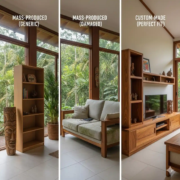
Mass produced furniture often uses soft woods or engineered materials that do not last long in the tropics. In contrast, custom wood furniture Costa Rica craftsmen create is designed to withstand local conditions. This makes the furniture stronger and more durable.

Local craftsmen take time to sand, treat, and finish the wood correctly. They do not rush the process. The result is furniture that is beautiful, long lasting, and made with care. When you buy custom furniture, you are supporting local craftsmanship and gaining a product made with pride.

Designed for the Tropical Climate

The tropical climate of Costa Rica affects furniture in many ways. High humidity can cause swelling, mold, and warping. Sunlight can fade soft finishes. Salt air near the coast can damage metal and untreated wood.

Custom furniture for homes in Costa Rica is built specifically for these conditions. Local workshops understand the climate and use proper treatments to protect the furniture. They select materials that resist humidity and last longer in tropical environments. This includes hardwoods, marine grade finishes, durable oils, and natural resins.

Furniture that is not designed for tropical climates often develops problems such as mold growth, chipped finishes, weak joints, or uneven surfaces. Custom pieces reduce these risks because they are made with climate friendly materials.

Perfect Fit for Home Layouts and Room Sizes

Many homes in Costa Rica have unique layouts. Some are built on sloped land with specific room shapes. Others include open concept areas, high ceilings, and custom windows. Ready made furniture may not fit these spaces correctly.

Custom furniture solves this problem. You can request any shape, size, or configuration. This is helpful for closets, kitchen cabinets, built in furniture Costa Rica designers often create, and spaces with unusual dimensions. Custom furniture can also be built to maximize storage in smaller homes or create elegant designs in larger homes.

A perfect fit provides comfort, style, and better use of space. Your furniture becomes part of the architecture instead of something placed inside the room.

Better Material Selection and Natural Resources

Costa Rica offers some of the best hardwoods in Central America. Many are locally sourced and known for their strength. These woods have natural resistance to humidity and insects. They provide warm colors, beautiful grain patterns, and long lasting performance.

Imported furniture often uses materials that are not ideal for tropical homes. Some materials weaken in moisture or heat. Soft woods may bend or warp. Engineered wood products may expand or bubble in humid environments.

When you choose custom furniture in Costa Rica, you gain access to high quality natural materials and better control over the final product. You can choose from teak, cedar, laurel, almond, or guanacaste. Each wood offers different colors and textures, allowing you to create interiors that reflect your personal style.

Unique Designs That Match Your Costa Rica Lifestyle

Every homeowner has a unique lifestyle. Some want open spaces for entertaining. Others want cozy furniture for family living. Many expats want a combination of comfort and tropical style. Custom furniture supports all of these needs.

Furniture design Costa Rica professionals understand both traditional and modern styles. They can create pieces that match your interior theme whether you prefer contemporary, rustic, tropical, minimalist, or luxury designs. Custom furniture allows you to add personal touches that make your home feel more like yours.

This personalized approach ensures that your furniture reflects your taste and fits the way you live.

Long Term Value and Durability

While custom furniture may cost more upfront than mass produced furniture, it lasts much longer. High quality hardwood, skilled craftsmanship, and proper finishing techniques ensure long term durability. You will not need to replace the furniture frequently.

Mass produced furniture often lasts only a few years in the tropics before it begins to show signs of wear. Custom furniture remains strong for decades. This makes it a smart financial decision and increases long term value in your home.

Homes in Costa Rica that feature custom furniture also appeal more to buyers. Many property investors choose custom interiors because they increase the value of the property and improve the overall presentation.

Storage Solutions and Built In Features

Many homeowners prefer built in furniture Costa Rica workshops can manufacture. Built in furniture includes closets, entertainment units, kitchen cabinets, office spaces, and bathroom vanities. These pieces create clean lines, better use of space, and a modern look.

Custom cabinetry Costa Rica builders create allows you to design storage that fits your needs. You can add drawers, compartments, shelves, or soft close mechanisms. This leads to better organization and a more comfortable living environment.

Built in furniture also blends with the walls and structure of the home. It creates a polished finish that is difficult to achieve with store bought pieces.

Eco Friendly and Locally Sourced Materials

Costa Rica has strong environmental values. Many furniture workshops follow responsible sourcing practices. They use wood from managed forests and support reforestation efforts. Choosing handmade furniture Costa Rica artisans produce helps reduce long distance shipping and its environmental impact.

Custom furniture uses natural finishes, low toxin materials, and sustainable production practices. This creates a healthier home environment and supports local communities.

Supporting Local Economies and Skilled Artisans

When you purchase custom furniture in Costa Rica, you support local jobs and skilled craftsmen. This contributes to the economic development of the region. Many artisans have generations of experience and take pride in their work.

Supporting local craftsmanship helps keep cultural traditions alive. It also strengthens the relationship between homeowners and the surrounding community. Investing in custom furniture benefits both the homeowner and the local economy.

Budget Friendly Options Without Sacrificing Quality

Custom furniture does not always mean expensive. Many workshops offer budget friendly designs that use local materials and simple finishes. Because you have full control over dimensions and materials, you can choose options that fit your budget.

Mass produced furniture may seem cheaper, but frequent replacements and poor durability often lead to higher long term costs. Custom furniture gives you better value over the life of your home.

Conclusion

Custom furniture is the best choice for homes in Costa Rica because it offers durability, climate friendly materials, personalized design, and long term value. Local craftsmen create furniture that fits your home perfectly and lasts for many years. Whether you want built in cabinets, custom wood furniture, or handmade pieces that reflect your style, custom furniture gives you flexibility and quality that mass produced items cannot match. It supports local artisans, enhances your home design, and provides comfort in the tropical climate.

Why Choose Us

We design and build custom furniture for homes across Costa Rica. Our team works with high quality hardwoods and offers complete customization to match your style and space. We provide custom cabinetry, built in furniture, and handcrafted pieces designed for tropical living. Our focus is on durability, beauty, and craftsmanship. If you want custom furniture that enhances your home and fits your lifestyle, our workshop provides expert support from planning to final installation.

Frequently Asked Questions

What wood is best for custom furniture in Costa Rica
Teak, cedar, and guanacaste are popular because they resist humidity and insects.

Is custom furniture more expensive than store bought furniture
It depends on the materials and design, but custom furniture offers better long term value and durability.

Can custom furniture match my interior design style
Yes. Custom furniture can be made in modern, rustic, minimalist, or traditional styles.

Does custom furniture handle humidity better
Yes. Local craftsmen use treatments and hardwoods that resist moisture in the tropical climate.

Can custom furniture include built in storage
Yes. Built in closets, cabinets, and entertainment units are common custom pieces in Costa Rica.

Why Hire a Local Construction Crew in Costa Rica Instead of Outsourcing

Why Hire a Local Construction Crew in Costa Rica Instead of Outsourcing

Building a home in Costa Rica is an exciting experience for many people who want a peaceful lifestyle, beautiful nature, and a comfortable place to live. As more families, retirees, and investors arrive in the country, the demand for high quality construction continues to grow. One question that many new property owners ask is whether they should hire a local construction crew in Costa Rica or outsource the work to contractors who are not based in the region. This is an important decision because it affects quality, cost, timeline, communication, and long term value.

Working with a local construction crew in Costa Rica offers advantages that are difficult to match with outsourced teams. Local builders understand the land, the climate, the building standards, and the permit system. They know how to design and construct a home that performs well in tropical conditions and meets local regulations. Outsourcing may seem cheaper or more flexible at first, but it often leads to delays, unexpected problems, and communication issues. This guide explains why it is better to hire a local construction crew in Costa Rica instead of outsourcing, using simple and clear wording for anyone who is new to construction.

Introduction to Home Construction in Costa Rica

Costa Rica has unique construction requirements. The climate includes heavy rains, sunlight, humidity, and coastal winds. The country also has specific building rules that protect safety and the environment. These rules apply to foundations, drainage, electrical systems, and structural design. Local builders understand these standards and follow them naturally because they work with them every day.

Outsourced contractors may not understand these conditions. They may use the wrong materials or overlook important steps that protect your home from moisture or soil movement. When planning a home in a tropical country, experience with the region is one of the most important factors. This is why many people choose construction services in Costa Rica that use local crews instead of outsourcing.

Understanding the Local Construction Landscape

When you talk to local builders in Costa Rica, you will notice that they have deep experience with the land and climate. They understand how soils behave in different regions. They know where to place drainage lines to avoid flooding. They understand how roof angles change based on the amount of rain in a region. They also understand how to work with local authorities and municipalities.

A local construction crew Costa Rica team is familiar with the pace of each region. They know how long materials take to arrive. They understand the connection processes for water and electricity. Local experience reduces mistakes and keeps the project moving smoothly. Outsourced crews often underestimate the challenges of working in a new environment and make decisions that do not fit local conditions.

Local Knowledge of Climate and Materials

Costa Rica has strong sun, heavy rain, and warm temperatures. Certain materials perform better in this environment than others. Local builders know which materials last longer in coastal areas and which ones work best in the mountains. They understand how humidity affects finishes, wood, metals, and electrical systems.

Outsourced contractors may not understand how quickly moisture damages untreated materials. They may choose finishes that look attractive but do not last long in tropical conditions. Working with local builders in Costa Rica protects your investment because they select materials that can withstand the climate.

Another benefit is that local crews know where to source reliable materials. They have relationships with suppliers and can secure items faster and at better prices. Outsourcing often means higher transportation costs and slow delivery times.

Better Communication and Daily Supervision

Communication is one of the most important parts of any construction project. When you hire a local construction crew in Costa Rica, you gain a team that can communicate with you clearly, update you regularly, and supervise every step of the process. Daily supervision ensures quality and prevents mistakes.

Outsourced teams may not be present on site each day. They may rely on phone calls or long distance management. This often leads to confusion and delays. Local construction crews can work directly with architects, engineers, and inspectors in the region. They can resolve issues quickly because they are physically available.

If you are an expat living abroad during construction, having a local team offers peace of mind. They understand the importance of communication with international clients and provide updates through photos, videos, and weekly reports. This level of contact is difficult to achieve with outsourced teams.

Faster Response to Issues on the Job Site

Construction sites experience unexpected changes. Soil conditions may differ from what the survey predicted. Weather may affect the schedule. Material availability may shift. A local crew can respond quickly to these issues. They can adjust plans, request approvals, and coordinate with the municipality on the same day if needed.

Outsourced contractors often take longer to respond because they do not have the same level of local presence. They may not know who to contact or how to solve issues according to local rules. Delays can add weeks to the timeline and increase costs.

Local builders in Costa Rica protect your schedule because they can solve problems immediately. This speed improves efficiency and reduces stress.

Strong Understanding of Local Labor Standards

Costa Rica has labor rules that protect workers. Local construction crew Costa Rica teams understand these rules and follow them correctly. This includes safety rules, insurance, and workplace requirements. It also includes fair treatment and proper employment practices.

Outsourced contractors may not follow these rules, which can create legal problems for the property owner. In Costa Rica, the property owner can be held responsible for labor issues if the contractor is not compliant. Hiring a local construction crew ensures that all labor is handled correctly and legally.

This is an important part of construction services in Costa Rica because it protects your project and ensures that the workforce is treated properly.

Better Coordination With Local Government and Permitting Offices

The permit system in Costa Rica requires clear communication with municipal offices. Local builders know the staff, the requirements, and the correct procedures. They understand how to prepare documents for inspectors and how to schedule site visits.

Outsourced teams often struggle with this step. They may prepare documents incorrectly or misunderstand what the municipality requires. This can lead to rejection, corrections, and delays.

Local builders in Costa Rica also understand environmental rules. They know when certain approvals are required and when they are not. This knowledge reduces errors and speeds up the permitting stage.

Cost Efficiency and Budget Friendly Construction Planning

Hiring a local construction crew in Costa Rica is often more cost effective than outsourcing. Local teams know how to plan budgets that match local prices, local materials, and local labor conditions. They can build budget friendly options that do not compromise quality.

Outsourced teams often underestimate costs because they do not understand local pricing. They may choose materials that are more expensive to import. They may also charge more for travel, accommodation, and transportation.

Local builders use efficient supply chains. They can negotiate better prices and manage resources carefully. This keeps your project within budget and prevents unexpected expenses.

More Reliable Timelines and Predictable Scheduling

Construction projects require careful scheduling. Weather, material availability, inspections, and labor all affect timelines. Local construction crews can predict these conditions accurately. They understand the rainy season, the dry season, and how weather changes by region.

Outsourced contractors often misjudge timelines because they do not have this local knowledge. They may plan schedules that are not realistic. This leads to delays and frustration.

If you want a project to move smoothly, choosing local builders in Costa Rica provides better control over scheduling. They can adjust plans quickly and keep the project moving at the right pace.

Cultural Understanding and Local Relationship Building

Working with a local construction crew in Costa Rica creates a strong relationship between you and the community. Local builders understand cultural expectations and communication styles. They work with respect and care for the land and the environment. They understand how to coordinate with neighbors and local businesses.

Outsourced teams may not understand cultural differences. This can create tension or misunderstandings during construction. Local crews build trust through clear communication and community awareness.

This is especially important for expats who are building a home in a new country. Local builders help you understand local practices and ensure that the project runs smoothly.

Accountability and Long Term Support

When you hire a local construction crew in Costa Rica, you can rely on them for long term support. After construction is complete, they remain available for maintenance, repairs, or adjustments. Their reputation depends on the quality of their work, so they take responsibility for every detail.

Outsourced teams often leave after the project and are difficult to contact later. If something needs correction, you may not have anyone to support you.

Local builders offer reliable aftercare. They can return to your property when needed and provide expert advice based on local experience. This makes them the best choice for long term value.

Conclusion

Hiring a local construction crew in Costa Rica provides advantages that are essential for quality construction. Local builders understand the climate, the materials, the land, and the permit system. They communicate clearly, respond quickly, and follow all labor and safety rules. They offer budget friendly solutions, predictable scheduling, and long term support. Outsourcing may seem attractive at first, but it often leads to delays, miscommunication, and higher costs.

When building a home in a tropical country, experience and local knowledge matter more than anything else. Choosing a local construction crew protects your investment and ensures a smooth and successful building experience. This guide explains the expert reasons to hire a local construction crew and shows why local teams offer the best results for construction services in Costa Rica.

Why Choose Us

We provide complete architectural, engineering, and construction services across Costa Rica. Our team is based in the country and understands the land, the climate, and the permit system. We manage every stage of construction with care and professionalism. Our clients receive clear communication, predictable timelines, and long term support. When you want a trusted local partner for your home in Costa Rica, our team delivers quality work and expert guidance from start to finish.

Frequently Asked Questions

Is it cheaper to hire a local construction crew in Costa Rica
Yes. Local crews understand local pricing and can plan a budget friendly project without surprises.

Do local builders provide better quality
Local builders work with local materials and know how to build for the climate, which improves quality and durability.

Can outsourced contractors work in Costa Rica
They can, but they usually face delays and may not understand local rules or climate needs.

Do local builders handle permits
Yes. Local construction services know how to prepare documents and coordinate with municipalities.

Is communication easier with local builders
Yes. Local teams provide daily supervision, regular updates, and clear communication throughout the project.

How to Hire a Contractor in Costa Rica: The 2026 Comprehensive Guide

Why Hire a Design & Permitting Expert in Costa Rica | Build Smart

Why You Should Hire a Design & Permitting Expert in Costa Rica

Building a home or commercial property in Costa Rica can be an exciting experience, but it also involves a detailed process that many people underestimate. From architectural drawings to municipal submissions and environmental approvals, even small construction projects require official permits before work begins.

For many homeowners, especially foreigners, the legal and technical requirements can feel overwhelming. That’s where a professional design and permitting expert becomes essential. These professionals manage every stage of design documentation, compliance, and approval, saving you time, money, and stress.

In this guide, we’ll explore why hiring a design and permitting expert in Costa Rica is not only recommended but necessary for a smooth, legal, and efficient construction process.

1. Understanding Costa Rica’s Construction Permit System

Costa Rica’s construction industry is well-regulated to maintain safety, sustainability, and community standards. All building projects, from private homes to pools or extensions, require approval from local municipalities and the Colegio Federado de Ingenieros y de Arquitectos (CFIA).

The permit process involves several steps: architectural design submission, environmental evaluation, utility approvals, and municipal inspections. Each phase requires technical drawings and documentation prepared by certified professionals. Attempting to handle this alone can result in costly delays or even legal fines.

2. The Role of a Design and Permitting Expert

A design and permitting expert bridges the gap between your vision and Costa Rica’s regulatory framework. They ensure your project meets local codes while keeping design aesthetics intact.

Their responsibilities include developing architectural and structural plans, coordinating with engineers, preparing municipal submissions, and securing approvals from the CFIA. They also communicate with environmental and utility agencies when required. With professional oversight, your project remains compliant, organized, and on schedule.

3. Avoiding Costly Delays and Rejections

Many property owners underestimate how strict Costa Rica’s building permit process can be. Submitting incomplete drawings or incorrect documentation often leads to rejection and weeks of lost time.

A permitting expert reviews all submissions to ensure accuracy before sending them to the relevant authorities. They anticipate potential issues, reducing the chance of resubmissions or stalled approvals. By preventing errors early, you can avoid unnecessary expenses and begin construction faster.

4. Legal Compliance and Peace of Mind

Building without proper authorization in Costa Rica can result in heavy fines, work stoppages, or even demolition orders. A licensed design and permitting expert ensures your project complies fully with Costa Rican construction law.

They understand zoning restrictions, environmental obligations, and structural safety standards. Having their support means you can proceed confidently, knowing your investment is legally protected from start to finish.

5. Saving Time Through Professional Coordination

Time is one of the most valuable assets during a construction project. Coordinating between architects, engineers, and municipal offices requires constant communication and follow-up.

Permitting experts handle these tasks on your behalf. They know which documents each office requires and how to streamline submissions. This expertise can cut approval time significantly, keeping your project on schedule while you focus on planning the design and lifestyle details of your new property.

6. Expertise in Architectural and Structural Design

Design professionals in Costa Rica do much more than draw blueprints. They create spaces that blend functionality, aesthetics, and sustainability while adhering to local regulations.

A qualified expert will evaluate your land, topography, and environmental conditions before preparing drawings. They recommend appropriate materials and structural systems suited to Costa Rica’s tropical climate. This ensures that your property is not only beautiful but also resilient and efficient.

7. Environmental Responsibility and Sustainability

Costa Rica’s government prioritizes sustainability, and environmental permits play a key role in construction approval. Certain projects require assessments from SETENA (Secretaría Técnica Nacional Ambiental) to ensure they don’t harm natural ecosystems.

A permitting expert guides you through these environmental obligations, helping you select eco-friendly materials, waste management systems, and water-saving designs. Their knowledge ensures your project aligns with national environmental goals while maintaining high construction standards.

8. Foreign Ownership and Permitting Challenges

Foreign investors and expats often face additional challenges when navigating local bureaucracy. Differences in language, documentation style, and local procedures can create confusion.

Hiring a local expert simplifies everything. They act as your representative, communicate with authorities in Spanish, and ensure documents meet legal standards. Whether you live abroad or locally, having a trusted permitting consultant guarantees that your interests are managed professionally.

9. Cost Efficiency and Budget Control

Many property owners assume managing the permit process independently will save money. In reality, mistakes in submission or design errors often lead to rework, which increases total costs.

A permitting expert provides accurate estimates and ensures compliance from the beginning. They help you avoid surprise fees, redundant drawings, and fines. Investing in professional guidance from the start keeps your overall budget predictable and efficient.

10. Integration with Construction and Project Management

Design and permitting experts often collaborate directly with construction teams, ensuring that approved plans are followed precisely during building. This integration reduces miscommunication and prevents structural or architectural inconsistencies.

When your contractor and permitting expert work together, construction progress becomes smoother. Reputable companies like Finish Touch Enterprises offer both design and permitting services in-house, providing clients with one coordinated team that handles every phase from planning to completion.

11. Staying Updated on Local Regulations

Building codes and municipal requirements can change annually. Experienced permitting professionals stay current with these updates, guaranteeing your project follows the latest laws.

For example, updates in zoning, safety codes, or environmental laws may affect certain designs. Having an expert on your side ensures you never face compliance issues later, which could delay occupancy approval or resale.

12. Added Value When Selling or Renting Property

Properties built with proper permits and professional designs hold greater resale value and credibility. Future buyers or renters often request proof of compliance, and having a clear permitting record increases trust.

A well-documented project also simplifies obtaining insurance or financing since banks and insurers in Costa Rica require legal proof that your structure was built with official approval.

13. Choosing the Right Design & Permitting Partner

When selecting a design and permitting expert, look for certified professionals registered with the CFIA. Check their previous work, client testimonials, and communication style.

Experience matters   especially for complex projects like hillside homes, beachfront villas, or eco-friendly builds. A reliable company should explain the process clearly, provide transparent pricing, and coordinate with engineers and surveyors efficiently.

14. The Design-Build Advantage

Some construction companies in Costa Rica, including Finish Touch Enterprises, offer complete design-build services. This model means that one team handles design, permitting, and construction, creating smoother coordination and faster delivery.

It eliminates the confusion of working with multiple providers and ensures the project maintains the same vision from concept to completion. This integrated approach is especially valuable for foreign investors or first-time builders unfamiliar with Costa Rican procedures.

15. Common Mistakes to Avoid

One of the biggest mistakes homeowners make is beginning construction before permits are finalized. Others submit incomplete documentation or hire unlicensed designers, resulting in rejections or fines.

Avoid shortcuts and rely on certified professionals who understand the process from beginning to end. Proper preparation will always save more time and money than last-minute corrections.

16. A Smooth Start to Your Costa Rican Dream Home

Whether you’re building a new house, a rental villa, or expanding your property, professional design and permitting guidance ensures your dream takes shape legally, safely, and efficiently.

Costa Rica offers a welcoming environment for builders, but its regulations demand precision. A qualified expert makes the journey easier, allowing you to focus on the excitement of building rather than the complexity of paperwork.

Conclusion

Building in Costa Rica can be an incredibly rewarding experience when it’s done right. However, even the most exciting project can quickly become stressful without proper guidance through design and permitting. Each municipality has its own set of rules, forms, and documentation, which can easily overwhelm someone unfamiliar with the process.

Hiring a design and permitting expert ensures everything moves efficiently and legally from day one. They not only translate your ideas into functional architectural plans but also take care of compliance, environmental approvals, and official submissions. By entrusting professionals, you protect your investment, avoid unnecessary delays, and gain peace of mind that your home or commercial space meets Costa Rican standards in every aspect.

When done under professional supervision, construction in Costa Rica is smooth, predictable, and deeply satisfying — a perfect start to creating your dream property.

Why Choose Finish Touch Enterprises

Finish Touch Enterprises has earned its reputation as a trusted leader in Costa Rica’s construction and design industry. The company provides a complete range of architectural, engineering, and permitting services, guiding homeowners and investors through each stage of project development.

What makes Finish Touch Enterprises stand out is its integrated approach. Rather than relying on multiple service providers, clients benefit from a single, coordinated team that handles everything  design, documentation, municipal approvals, and construction. This saves time and ensures consistent quality across all phases.

Here’s why homeowners, expats, and investors continue to choose them:

  • Full-service expertise: Design, permitting, and construction handled seamlessly under one roof.
  • Regulatory knowledge: Deep understanding of CFIA and municipal processes across Costa Rica.
  • Local and foreign client support: Bilingual project management that ensures clear communication.
  • Proven quality: Every project follows strict standards for structure, safety, and sustainability.
  • Transparency: Clear timelines, open communication, and honest cost control at every step.

When you work with Finish Touch Enterprises, you don’t just hire a contractor — you gain a dedicated partner committed to bringing your vision to life with professionalism and precision.

Frequently Asked Questions

1. Do I need a permit to build a house in Costa Rica?

Yes. All construction projects, whether residential or commercial, require official permits from local municipalities and the Colegio Federado de Ingenieros y de Arquitectos (CFIA). Starting work without approval can result in fines or legal action.

2. How long does it take to get a building permit in Costa Rica?

The approval time varies by location and project size. For residential homes, the process typically takes between four to eight weeks once all documents are submitted correctly. Working with an expert significantly shortens this timeline.

3. What documents are needed for a construction permit?

You’ll need architectural and structural drawings, land ownership proof, zoning certificates, and environmental assessments if required. A professional designer prepares and submits all of these to the relevant authorities.

4. Can foreigners apply for building permits in Costa Rica?

Yes. Foreigners can own land and apply for building permits just like Costa Rican citizens. However, most municipalities require that official submissions come from licensed architects or engineers registered with the CFIA.

5. Why should I hire a permitting expert instead of doing it myself?

The permitting process involves technical details and local regulations that are hard to navigate without experience. Experts ensure compliance, prevent delays, and manage communication with government offices, allowing you to focus on your project.

6. How much does it cost to hire a design and permitting consultant in Costa Rica?

Costs depend on project complexity, location, and design scope. Generally, permitting services represent a small percentage of the total construction cost and can save thousands by preventing errors or rejections.

7. What happens if I build without a permit in Costa Rica?

Building without authorization can lead to work stoppage, penalties, or demolition orders. It can also make it impossible to sell or insure your property later. Always secure proper permits before starting any construction.

8. What is the CFIA and why is it important?

The CFIA (Colegio Federado de Ingenieros y de Arquitectos) is Costa Rica’s official governing body for architects and engineers. It reviews and approves construction plans to ensure safety and compliance with national standards.

9. Can Finish Touch Enterprises handle my entire permit process?

Yes. Finish Touch Enterprises provides complete design and permitting services, including municipal submissions, CFIA registration, and environmental coordination. They manage the entire approval process from start to finish.

10. How do I choose the right design and permitting expert in Costa Rica?

Look for certified professionals with verifiable CFIA credentials, transparent pricing, and proven local experience. Always review their past projects and client testimonials before making a decision. Working with established companies like Finish Touch Enterprises ensures your project runs smoothly and meets all legal requirements.

Logical Square Corners - Pool Construction

Custom Pool Design and Construction

Finish Touch Enterprises SRL with the sole objective to deliver custom Pool Designs and Construction. Those are professionally engineered.

Custom Home Designing Service

Home Designing Service Details

This article will discuss what is included in your Custom Home Designing Service.  With Finish Touch Enterprises SRL

Home Designing ServiceI’ve written a series of articles that will answer a lot of people’s questions.  In the past 12 years of Designing and Building Homes in Costa Rica.  I have had my share of questions.  Many regarding the Home Designing Service.  So, therefore, I will attempt to make clear what is involved and what you will require.

I have structured the business model of Finish Touch Enterprises to be an ‘all in’ and ‘all inclusive’ company.  Meaning, there are no unforeseen surprises.  Our rates and services include all costs, including permit fees and mandatory insurance.

How Finish Touch Enterprises SRL Improves Your Experience

Finish Touch Enterprises SRL is a full-service Architectural Firm and a General Contractor in Costa Rica.  We are a company with continual growth by helping families and investors transition to Costa Rica living.  Specifically, our objective is to offer the best solutions with superior results.  Including offering the lowest prices with our Building Services and Home Designing Services.  This was accomplished by firstly, eliminating the middle man.  Secondly, less outsourcing of professional services.   Thirdly, equip the company with the necessary tools and equipment.

In most cases, a corporation’s business model consists of board members.  Each of them is a professional in their own area of studies.  Finish Touch Enterprises SRL adheres to the same format.  With a professional designing team, with each of them contributing specifics to their own area of studies.  Results with a complete and superior design.  Professionals that consist of architects, electrical engineers, structural engineers, interior designers, and more

The following list of Home Designing Service

  • An architect: for designs, drawings, elevations
  • The structural engineer: for footings, columns, roof design, red steel designs, connects, etc
  • Electrical engineer: receptacle and switch locations, load calculations, lumens calculations, service entry design
  • Interior decorator: designs for colors, textures, materials, niches, lighting, plumbing, and electrical fixtures
  • Permanently employed construction crews: Training men for specific skills
  • Heavy equipment for lot preparation, pool excavation, lot access, road building
  • Delivery trucks. No waiting, no extra delivery fees
  • Full-service woodshop creates custom kitchen cabinets, custom interior doors, custom entranceway doors
  • Stone profiling and polishing for granite countertops, stone sculpting and polishing for granite sinks, stair treads, window sills, etc
  • Window distribution license direct from the manufacturer, no middle man.  Warehouse prices directly to you
  • Pool equipment distributor direct from Pentair manufacture, no middle man.  Warehouse prices directly to you
  • Pebble pool finishes and glass bead aggregates
  • Fully insured company
  • Lísense with the Colegio Federado De Arquitectos Y Ingenieros De Costa Rica CFIA

Hire an architecture firm for home designing service

Designing a house in Costa RicaTo begin, when you are hiring an architect or architecture firm for your home designing service.  There will be many decisions to be made.  To begin, once your floor plan has been established and elevations.  You’ll begin to decide on finishing materials that cohere to the home aesthetics.  I call this the lipstick and mascara part.  Because it’s about colors, textures, material choices.  This can be overwhelming which is why our staff is here to take the difficult decisions.

When entering into a Home Design Service Agreement you will ask what is included and you will ask about costs.

  • Which materials and quality of materials will be used?
  • Details of the wall material
  • What will the roof consist of?
  • Flooring material and budget
  • Details of the type of windows that are going to be installed
  • Plumbing and lighting fixtures and budgets
  • Who will be reviewing the project and inspections
  • Cost for a complete design and permitting process

Engineered Systems for your Custom Design Service

Important to realize is there are many engineered systems, which are fabricated offsite transported to your property, and installed.  Many of these systems claim to save you time and money.  But most come with the sacrifice of quality.

If your designer is recommending an engineered system.  It may be necessary to do some research as to how you will benefit.  It is common for commissions to be paid for referrals.  Therefore you will want to validate that the recommendation is towards your benefit.  Not for the financial benefit of the one making the recommendation.

The thing that is important for your home design service is quality and function.  With being budget conscientious as well. In reality, you are going to enjoy this house for many years.  Therefore, it is more than an investment.  It is your home where memories will be made and cherished for a lifetime.  So incorporating the right systems is paramount.

What is included in your Homes Designing Service:

Costa Rica Architect FirmTo begin with the details of those questions.  Which is included in the Home Design Service Agreement with Finish Touch Enterprises SRL.

To begin the home designing service process you and I will begin to have a dialogue.  Perhaps by phone or through emails regarding your project.  We’ll be discussing the use of the home, whether it is a vacation home, retirement, permanent residence, or a rental income.  There are many variables all of which will influence design attributes and elements.

Further information as to your incision of home style.  Your likes and dislikes.  Must-haves, and necessities.  Your lifestyle particularly has a great influence.  Do you like to entertain groups of people or do you prefer a quiet lifestyle?  Do you spend a lot of time cooking or you don’t cook at all.  Again, there are many variables to influence your design.

In addition to a basic conversation for clarity and intention, we will discuss property budgets and all relevant articles.

Btw, budgets are always kept confidential.  Which are not shared with the staff.  It is best to have them focused on designing without restriction.  We will balance the design and budget

As a rule, I will visit the property to perform a pre-evaluation.  From there I would be checking for lot access and the ease of delivery vehicles have access.  I also look for lot servicing.  Neighbors and privacy issues.  Lot topography, tree evaluations.  I check for sun travel for morning and afternoon shade.  Focal points if any, and of course lot access for parking and turning around.

The home designing service agreement schedule includes:

    1. Preliminary studies of property
    2. Anti-project of property
    3. Geotechnical exploration and analysis
    4. Register Anti-Project to receive IVI reduction to 4%
    5. Conceptual design of floor plan and elevations
    6. Design finishes of exterior and interior materials/textures/colors
    7. Pool design and hydraulic engineered
    8. Detailed construction budget and schedule
    9. Detailed construction drawings
    10. Electric and mechanical design by certified engineers with CFIA
    11. Approval proceedings before the Costa Rican Engineers and Architects Bar
    12. Registration of professionals licensed with the CFIA for inspections
    13. Municipal approval process
    14. INS insurance (mandatory)
    15. Permits in hand

Home Designing Service Agreement Details

Project Stages: 

  1. Preliminary Studies of Property:

    1. Firstly, to begin with, a visit to the property.  This will actually be done periodically through the design process to verify elements.  The beginning visits are to determine the location of the house and outbuildings.  Lot access, parking, and turnaround.  This contributes to curb appeal.  Focal points exist or we need to create.  Neighbor location and privacy concerns.  Sun travel is also considered.  The natural lot topography and existing trees.  Lot servicing and any other attributes that will influence the design.
    2. Secondly, is the property amenities.  How near is the store, bank, clinic, restaurants, etc?  Some of these may have a factor on the design for storage or extra room, etc.
    3. Thirdly, is an interview with you to discuss the ‘must-haves.  What you are envisioning.  Your lifestyle and things you enjoy doing.  Are you entertainers or prefer a more relaxed quiet lifestyle?  A sports enthusiast, hobbies, activities, etc.  These attributes will influence living spaces, pool design, bedrooms, etc.
    4. Subsequently, the results from the above will initiate floor plan production.  As well as elevation plans of the house.  Including basic furniture layout and home attributes.  Which will encumber all attributes from the property inspection.  
  2. Anti-Project Of The Property:

    1. Creating an Ani-Project is basically a layout of your property.  We will show lot access and turn around.  House location, pool location, and gardens.  Basically, you will see social areas and the use of the land.  The ani-project will show all construction areas, fences if any, sidewalks, decking, etc.  From the approved anti-project, these attributes will be included in the construction drawings unless otherwise stated.
    2. We have a great deal of information on the Anti-Project.  You will find a North pointer in order to determine direction.  We include elevations of the building so it indicates the heights of the buildings.  The floor plan of the house is detailed so you can see the cohesion of indoor living with the outdoor living areas.  Often, we include tables of areas.  This gives a better understanding of proportion.  Air-conditioned areas to terraces, pool areas to decking, gardens or green areas, etc.
    3. The Anti-Project is also used for HOA approvals if relevant.  Often Asadas request an anti-project prior to approving a water availability letter.    
  3. Geotechnical exploration and analysis:

    1. Geotechnical Studies are not mandatory in Costa Rica and I’m not sure why, because they are extremely important.  These are soil studies on the property for density and perforation.  Importantly we want to know what lays beneath the home.  Often vegetative soil is about 12” on the surface of the property.  Which should be scalped off where construction will take place.  Then we need to know the density of the stabilized soil.  In order to calculate footing size.  Which is calculated by the weight of the house distribution over the soil density.  Also, we want to check soil up to 5 meters deep or to bedrock.  
    2. Perforation test tells us how quickly soil will absorb and drain water. We will design your stormwater management based on these studies.  As well as septic leach beds if applicable.
    3. Because these studies are not mandatory, many people believe they are not necessary.  For this reason, Finish Touch Enterprises has made Geotechnical studies a part of the design process and is included in the design fees.  They are important, and therefore, are included in your design file.
  4. Register Anti-Project to receive IVI reduction to 4%:

    1. This is fairly new to the Costa Rica permit process.  Costa Rica has initiated a goods and service tax of 13%.  Before, it was only a sales tax of 13%, but now it applies to all services in Costa Rica.  Of course, this was met with resistance from us architects and builders and for that reason, Congress temporarily suspended this tax for Architects, Engineers, and construction services.  In order to receive an exemption, a project needed to be registered with CFIA to receive an exempt number from Hacienda.
    2. September 1, 2021, this exemption was revoked and now a 4% service tax IVI will apply to construction services including designing.  However, you still must register the anti-project to receive the 4% reduction.  We include this process and registration fees as a part of our Custom Design Agreement
    3. It is also worth noting here that as of September 1, 2022, the 4% will increase to 8%
  5. Conceptual Design of Floor Plan and Elevation:

    1. Conceptual meaning starting point.  From all the data collected from the site visit, interview, and studies.  We will then begin with a preliminary design.  This design will be more detailed towards function, aesthetics, and budget conscience.  Much of this was completed for the anti-project.  But now we get into the details.
    2. Following the floor plan, we then design elevations.  This includes wall heights, ceiling heights, architectural ceiling designs if applicable, roof design, window, and door placement, sizes, and designs.
  6. Design Finishes of Exterior and Interior Materials/Textures/Colors:

    1. Our designers will then add some color, texture, and materials to the design. This is a part when things start to get exciting.  I call this part the ‘lipstick and mascara’ part.  As now house develops a personality reflecting its owner’s visions.  There is a cohesion of ceiling designs, floor tiles, feature walls, cabinets.  All of which set the mood.  From rustic to elegance.
    2. For visual reference, we create 3D renders to best communicate with you the aesthetics.  With this technology, it is as close to reality as we can get.  Of course in real life, there will be deference to a degree.  But it best depicts the end goal with reasonable accuracy.
    3. With the conceptual drawing and renders, we can more accurately calculate costs.  As we now have a drawing for material take-offs for exact measures of flooring, cabinets, block, concrete, etc.  As well as, renders for material choices, placements, and measures.
  7. Pool Design and Hydraulic Engineering:

    1. Pool designs and engineering are critical components of a home design.  This is a whole field of its own and requires much care and consideration.  The pool area will most likely be the area most used in a home design.  You will spend more time here than anywhere else in the home.  Not just for usage, but for visual serenity.  Often the pool area is seen upon entering the home for the ‘wow’ effect.  Knowing this, we at Finish Touch Enterprises, take much care and professional adherence and dedication to your pool design.
    2. To begin, the pool design should be a part of the house, not an add-on.  So we try to incorporate some home attributes and elements into the pool.  To give an adhesion between the two.  Also, size in proportion to the house and number of occupants.  All pools are custom designed and not pulled out of a book.  So we can include many features and conveniences to suit the families’ preferences.  Example; beach entry without steps, water cascades, infinity edge, bubblers, seating areas, light show, firewater, swim-up bar to an outdoor kitchen. etc.
    3. For more detailed information regarding the pool design.  We recommend reading this article Pool Design and Construction
  8. Detailed Construction Budget and Schedule:

    1. Collectively, this is a document that jointly goes with your construction drawings.  The construction drawings give you details of measurements.  Locations of attributes, and construction details of material quality.  The Detailed Construction Budget and Schedule are more inclusive of what you will receive.  Budgets on flooring, granites, taps, plumbing fixtures, lights, fans.  Most often builders don’t demonstrate what quality they use on these elements.  But we give you a 15-page document of all material breakdown quantities and cost
    2. The budget begins with relevant data.  Between the property and Finish Touch Enterprises.  This data is regarding Finish Touch Enterprises address, contact info, and General Contractor license info.
    3. The summary page of areas and costs of areas per meter squared.  What is included in the proforma and what is not included?
    4. Individual material quantities and costs.  This area is generic so when you read a ‘0’ in a quantity column, you know your house does not have this item.  However, if you choose to want this item, you will know what the cost is upfront.  Example.  If you did not want a hot water tank and preferred hot water on demand, your proforma will show the cost upfront.  We provide no surprises and total transparency.
    5. In addition, the proforma has labor costs to build this home which includes government responsibilities.  There is summary pages where you can view all cost collectively.
    6. The final pages show a schedule for the installation of the materials with a flow chart.  Followed by a monthly/weekly chart of costs during the progression of the construction.
  9. Detailed Construction Drawings:

    1. You will receive a complete set of construction drawings physically and digitally.  These drawings usually consist of 20 to 25 pages.  Each page will have the approval seal of CFIA.  Meaning they are certified and approved before the Colegio Federado de Ingenieros y de Arquitectos de Costa Rica Bar (Federal Building Department).
    2. The drawings will include all relevant laminas to construct this home.  Sections on architectonics, elevations, cut sections, structural sections, electrical sections, mechanical sections, window/door schedules, areas, etc.
    3. Note: In addition, for your information purposes, with the construction drawings you can solicit builders for pricing or price comparisons.  We recommend you keep the proforma private for your personal comparisons.  With these two documents, you are best equipped for asking the correct questions.  Of course, we hope you continue with Finish Touch Enterprises as your builder.
  10. Electric and mechanical design and blueprints:

    1. After the approval of the conceptual drawing, we then get the engineers involved to make the design work.  Mandatory Electrical engineer and Mechanical engineer will be for every project.  There may be additional engineers required depending on specifics.
    2. The Electrical and mechanical engineers will firstly design to code and function.  Logically, this means we can see in the dark and water runs downhill.  Secondly, we continue these designs for function.  This includes 3-way switches at strategic points.  Location and heights of tv receptacles.  The convenient location of shower taps to showerheads.  And many other functions and features.  Thirdly, is aesthetics, our designers and engineers work together to finalize this stage.  This includes ambient lighting, wall washing lighting, task lighting.  Perhaps the vessel sinks with cascade taps.  Bathroom shower features.  Kitchen island features, and more.
    3. There are also careful considerations for HVAC designs.  Placements of ducting and returns for constant climate control.  Engineering for passive cooling is involved in this stage as well.  Telecommunications designs and any security considerations are done at this part.
  11. Approval Proceedings before the Colegio Federado de Ingenieros y de Arquitectos de Costa Rica:

    1. At the beginning of the project in step 1 above, we mention the collection of permit documents.  By the time we completed all the steps including the detailed construction drawings, we should have collected all required documentation for permitting.  We then submit the package to CFIA
    2. The package is examined and notification is sent that it is complete.  Should they require further documentation they will request it at this time.  Once the package is determined complete, it is assigned a reviewer
    3. The reviewer analyzed the drawings to confirm they comply with all Costa Rica Federal Building codes.  Which include seismic stability, structural safety factors, wall systems, and other systems that are Costa Rica certified.
    4. Within the CFIA are also additional departments that will review the plans.  This includes the Ministry of health for any black water designs, the Fire Department for egress designs, the Ministry of environment for environmental concerns, and so forth.
    5. Once all departments have approved the designs, we are sent an invoice for permit payment which is paid by Finish Touch Enterprises.  All fees are included in the Architect Agreement between Finish Touch Enterprises and the Client.
  12. Registration of professionals licensed with the CFIA for inspections:

    1. On all laminates of the Construction Drawings, there is a section on the right side that we call the Canteen.  This area is where the CFIA will stamp a seal of approval.  This area also shows the page number, which section it belongs to, property owner name, project name.  Most importantly, it shows the names and license numbers of the designers, engineers, architects, and builders.  These license numbers are verified by CFIA for validity as only licensed professionals can apply for permits.  These are the professionals responsible for the construction accuracy and perform inspections weekly.
    2. Should the client hire another builder to construct the home, these registered responsible would resign and the new builder would register his professionals if he has any.  Otherwise, the Client would need to sub-contract new professionals to be responsible for the build.  This is a bit of a hassle but is not uncommon.
  13.  Municipal approval process:

    1. Upon receiving the CFIA approval, the plans may then proceed to the Municipality.  The Municipality has a couple of obligatory reviews for the plans.
    2. Firstly, they will review the anti-project for building setbacks and lot coverage.  The federal building code has federal bi-laws.  the Municipality has additional bi-laws.  These are usually presented to us when we receive the ‘Uso Suelo’ (Use of Land) document.  It usually stated, how high a structure can be for that zone.  Property setbacks.  Amount or percentage of lot coverage.  The municipality does not check for structural compliance.
    3. Secondly, the approval stamp from CFIA will have a value of construction.  The Municipality considers this value as an improvement to the property.  They then include this value in the property value to calculate your new annual property tax amount.
    4. Thirdly, the Municipality will confirm there is construction insurance valid.
    5. Once all the above is valid and verified, we are sent an invoice for permit payment which is paid by Finish Touch Enterprises.  All fees are included in the Architect Agreement between Finish Touch Enterprises and the Client.
  14. INS insurance (mandatory):

    1. INS is an acronym for Instituto Nacional de Seguros.  Costa Rica has government insurance for homes, vehicles, and life.  There are no in-country insurance companies.  Any insurance plans you may consider from any company outside of INS, then you are purchasing insurance from an American Company or some other country abroad.  
    2. Nonetheless, INS is a mandatory insurance requirement for construction.  The amount of insurance to pay for your project is calculated from the value stamp of CFIA.  INS claims that 35% of that value is labor costs.  INS is 3.6% of labor costs.  Therefore, proof of this payment must be declared to the Municipality before they issue a permit. All fees are included in the Architect Agreement between Finish Touch Enterprises and the Client.
    3. NOTE: Should the Client employ other contractors, then the contractor must provide his own INS for his employees
  15. Permits in Hand:

    1. This is the end of the pre-construction stage.  We now have all permits to proceed with construction.  You have certified approved construction drawings, you have a 15 page detailed proforma of all materials, and budgets for finishes, as well as a timeline for construction.  You have federal and municipal permits and construction insurance.  Ready to begin construction.  The Architect Agreement is complete and ready for a Construction Building Agreement.  Hopefully with Finish Touch Enterprises SRL.

Federal Building Permit and Rates

Costa Rica Designing Services AgreementYou will see a copy of a physical federal building permit.  In the yellow highlight, area are two boxes above one another.  The upper box list architects’ duties before construction.  The architect checks the box for which he is responsible.  The box below is the architect’s duties during construction.  Again, he’ll check the boxes which are relevant.

Besides the duty description is a % of the fee for which an architect will charge.  Some of these are mandatory to be checked while others are suggestive.  Depending on the firm you are dealing with, the architect rates can vary from 8% to 13% of the project value.  Once the CFIA stamp with a value is received, then, these %’s are calculated to actual fee values and are sent to Hacienda.

Finish Touch Enterprises SRL is a General Contractor in Costa Rica.  Our objective is to get you to the building stage as soon as possible.  For this reason, our rates are less than the minimum rate.  Our rates begin at $25,000 and increase by 8% after a budget of $300,000. All-inclusive: fees for federal, municipal, and INS fees.  We also include the cost for soil studies.  We include all costs for electrical and mechanical engineering.  As well as additional staff for Interior Design/decorating.

This is what separates us from all other architect firms and general contractors.  We have a very simple all-inclusive, no surprises business model.


Designing a House In Costa Rica

Designing a House In Costa Rica

So here you are, Designing and Building a House in Costa Rica! Terrific! I look forward to having you as a new neighbor in Costa Rica’s Pura Vida!

Pura Vida translates into “the pure life” or “the simple life.” It is a commonly used phrase to say hello, good-bye, everything is great, and everything is cool! Pura Vida is not just an idiom in Costa Rica; It is a way of life in Costa Rica.

To enjoy the full benefits of Pura Vida, you must take that first step: designing a House in Costa Rica.

Design a home in Costa RicaWhether you are still in the process of dreaming about Building a House in Costa Rica.  Or you have taken the plunge into Pura Vida and are currently active in designing or building in Costa Rica.  I want to share some trade secrets to save you time and money.

As the founder and CEO of Finish Touch Enterprises SRL. I would also want to help you in laying out and designing your dream home. Your house’s design is crucial. Because the more organized, structured, and knowledgeable you are about designing and building in Costa Rica, the easier the start-to-finish transitions will be.

This article is specifically written as a starting point to create the demeanor to approach Designing a House in Costa Rica

Let us take a moment to digress…please read my articles about the designing processes, the steps involved to progress your custom home design.  Articles of your involvement and what you should communicate and methods of communicating with your architect or designer.  I have also written articles explaining professional involvements to complete a design and permits and what costs to expect.  We at Finish Touch Enterprises feel the best approach to relieving anxiety and skepticism is to educate people to understand the mechanics of Designing and Building a house in Costa Rica.

Designing and Building a House in Costa Rica on Paper

Any design model needs to be built on paper before it can be transformed into a tangible construction.  You should be working closely with your architect and builder to develop details.  That will include concise measures, materials, and delivery schedules.

Realistically, you should allow approximately 4 to 8 months for designing and permitting completion.  As well as attaining the required permits before construction can begin.  Do not rush your design process! This is a common error I see too often.  People want to start building today.  Without a good design and concise details, your project could soon turn into a disaster.  Try not to under-evaluate the importance of a complete and concise design.

Of course, even people who live in Pura Vida in Costa Rica, experience anxiety during this phase. That’s why I wrote this and other articles: to help you design your dream home effectively, efficiently, and with the least amount of anxiety.  This is and should be a pleasurable experience that you want to be proud of, for years to come.

Our Ideology of House Design

Our ideology at Finish Touch Enterprises SRL is to work closely and personally with every client and reduce any stress. One way to allay anxiety and stress is to have accurate, organized, and detailed-design plans, and permits.  Having a staff taking care of all the details big and small.  Sourcing specifics and unique elements, preparing imports if necessary.  Having a team on your side positively certainly reduces concerns, doubts, and fortifies confidence.

Even if you don’t choose to hire Finish Touch, (my personal recommendation), the success of your project directly results from competent, experienced professionals.  I make myself available for any who may have questions on concerns.  You don’t have to be a client to make contact with me in this regard.  With my Canadian background, I am always pleased to help.


Rule #1: You are The Boss when designing and Building a House in Costa Rica.


As I mentioned in a previous article, the people you hire may know all the terms, codes, and methods you don’t, but they still work for you. You have the right to be as involved as much as you want in the design process. Asking questions and holding professionals accountable are “not bothering them;”.  Asking questions and holding professionals accountable is good customer service.  In my past experience, I have had clients who were involved with every nail, screw, rebar, light bulb.  While other clients were, “don’t call me until your done”.  Either way is right.  This is your investment, this is your home, this is your project.  Your architect and builder are obligated to deliver to you results.  Including answering all questions of concerns, doubts, or uncertainty.

You are the boss.

Typical Beginning to Designing and Building a House in Costa Rica

The first professional with whom you’ll speak is a Licensed Architect.Designing a house in Costa Rica

It is the architect’s responsibility to draw the picture of your dream home.  Most architects do not have engineer training; therefore, the primary focus is on aesthetic and cosmetic attributes. The architect will take your ideas and visualizations and create a drawing on paper.

A good architect will work with you through multiple drafts until the visual on the paper matches the visual in your mind.  He will sketch a design with function, spirit, and artistic taste.

Produce a result

For your design to function well after you are satisfied with the general layout.  It may be necessary to involve other professional services.

An Electrical Engineer is mandatory on all Costa Rican house designs.  Also, it’s important if you are able, to participate in the electrical design.  Electrical codes are very much out of date in accordance with our electrical demands.  We have many more kitchen appliances, entertainment center appliances, bedroom gadgets, and we demand more convenient receptacles for charging units.  In addition, there is ambient lighting, task lighting, wall washing lighting, landscape lighting.  As you can see, many elements that you can participate in for the electrical design.

Depending on the size of the home, you may not be required to employ a Structural Engineer.  But having a Structural Engineer on-hand to review your preliminary plans before the detailed drawings are prepared benefits you.  This would include, a comprehension of the soil studies for footing size.  Lintel calculations, rebar sizes, frequency of rebar, structural roof design. etc.

Your Architect will generalize your structural footings, columns, and tie beams. In other words, that glass wall you envision may need some structural reinforcement.  Even the Architect’s final drawing is ill-defined without the engineering reviews.

House Designing prerequisites:

Because soil tests are not mandatory, people often overlook soil tests.  However, do yourself a favor and get soil studies on your lot. You, your engineer, and your builder need to know the structural characteristics of the ground, water dynamics, and filtration.

Also, you could even go a step further and ask a Structural Engineer to review the soil-studies results before designing a house. I personally have more than 40 experience in construction.  Have I got stories for you, from those who chose to skip certain engineering steps.  We at Finish Touch Enterprises SRL include soil studies in our Architect Agreement.  It is a part of your package and we also send the results to CFIA when submitting for a permit.

Note References for Designing and Building a House in Costa Rica.

Designing and Building a House in Costa Rica or any place is a complex process, which should not be executed by one person or a single architect. Pura Vida really does take a village.  Hiring the right team to make your dream house in Costa Rica a reality will make the entire journey easier and more cost-effective. Designing and Building a House in Costa Rica is your first step toward the Pura Vida.

There is no sure way for putting together your team of designers.  Every case and situation is a bit different.  You don’t want to hire someone overqualified as it is an unnecessary expense.  But on the contrary, you don’t want to hire someone underqualified.  As your end result could cost you much more than money.  Finding that sweet spot is knowing how to choose the team in the first place.  Not just the yellow pages, (that don’t exist in Costa Rica either).

There are articles on this website that if you take the time to read will give you the tools for choosing your team.  Take notes to what is relevant to your situation, know the right questions to ask, and know what answers should come back.  This can be fun and exciting as you will begin a whole new friendship.  Make sure to include Finish Touch Enterprises on your list for interviews.

Attributes of Designing and Building a House in Costa Rica

If you’re reading this article, you are probably considering designing and Building a House in Costa Rica.  Or at least, dreaming about designing a house in Costa Rica.

Lot Attributes;

Let’s talk aboutCosta Rica Architect Firm some essential design and property attributes.  This is the first step of putting together a vision.  That is the attributes of your lot.  To name a few would be; the lots focal points, topography, trees age and species, neighbors, sun travel, mechanical noises, or possible nature noises, rivers, any existing attribute that may influence the design elements.  More details here

Personal Attributes;

Having your personal attributes on hand makes the process of designing and Building a House in Costa Rica enjoyable and less stressful.  We recommend preparing by creating a “Designing a House in Costa Rica” Binder with Photos and Notes.  Not every attribute I discuss will be relevant to you.  So in keeping with the Pura Vida, jot down only those notes that are relevant to you.

Taking notes and creating a binder will not only help you stay organized but also help you see your dream become tangible. You can designate specific sections, such as designs, permits, soil studies, photos, expenses, electrical fixtures, plumbing fixtures, and schedules.  Also, you can even incorporate my articles in your binder for easy reference.

Have fun with your Designing and Building a House in Costa Rica Binder! Decorate or stylize your binder to reflect your aspirations and ideas. If you have not already done so, please, read the article: Costa Rica Architect Firm, which will explain what Finish Touch incorporates into every one of our designs.  Including your home and budget.

In your quest for the Pura Vida home, Two Attribute Categories deserve consideration: Property Attributes and House Attributes.

Designing and Building a House in Costa Rica: Property Attributes

1) Existing Topography in Costa Rica

When designing a home in Costa Rica, Property Attributes come first. What are Property Attributes? Primarily, existing topography (i.e., slopes, hills, terrain, and angles).designing a house in costa rica Americans often refer to the Western United States as God’s Country.  Costa Rica is also God’s Country.

Industries and prefabricated housing do not dominate the landscape. Nature created the land in Costa Rica, and Nature does not make mistakes.

Therefore, to fully enjoy all the beauty that Costa Rica has to offer, you probably want to keep the main features of your property as they are.

Topography analysis provides engineers with the necessary information they need.  For creating property access, including a place to park and maneuver vehicles.

Your actual home design may naturally conform to the side of a mountain or hill.  Understanding the basic topography and property elevations contributes to the home-design layout.

Which may include two stories, a basement walk-out, a raised or non-raised bungalow.  Or split-levels. Knowing the topographical benefits and limitations ultimately dictates how the house, perimeters, walls, and stories will be laid out.

Why do you have to know all this stuff? Knowledge is power and power is confidence. From a design point of view, you want to minimize the cost of your house’s foundation.  Or having to use budget funds for retaining walls.

2) Your Design’s Focal Point

Hire a builder costa ricaThat underlying beauty and variety of landscapes in Costa Rica create natural-design focal points. Which vista do you want to keep with your morning cup of coffee? Would you prefer a canopy or an oceanic view?  In the evening when you are sipping an adult beverage on the pool terrace?  If such a view does not exist on your property, then we will design and make one.  With tropical lush flora.

Do you even want a veranda? Knowing the focal point of your house design allows you to plan for particular house attributes. This is your dream—and Costa Rica is the most spectacular place to live out your dream.  So take advantage of every property and house attribute you can when designing and Building a House in Costa Rica.

3) Sun Travel On Your Property

There is an abundant amount of sun in Costa Rica.  Which is probably one of the main reasons you want to escape North America.  We have approx 8 hours of full sun rays per day compared to approx 3 hours of full sun in Canada and the northern states.  I shouldn’t have to explain the health benefits of the sun.  We’ve all learned a lot about the natural vitamin D and benefits of vitamin D against the covid calamity.

In addition, this amount of sun allows us to harvest its rays to produce electricity.  With an average of 8 hours of direct sun rays, the payback time for alternative energy of Photovoltaic is less than 5 years.  Wow, just imagine, free electricity for life.

The path the sun travels across your property can help you optimize your living space.  From a design point of view, sun travel considerations for windows locations, window sizes, location of bedrooms.  Sunsets, sunrises, sunny areas, and shaded areas.  Most people take this for granted.  Nonetheless, we use it to your advantage.

4) Privacy Considerations

Even in Costa Rica’s Pura Vida, you may want more privacy. When you’re having fun by the pool, or entertaining people for a bbq.  Perhaps a romantic moment with that special one.  In any situation, you want to feel secure, safe, and with complete privacy.  The list could be endless for reasons wanting your own personal privacy.  Therefore, your designer needs to analyze the best way to achieve this.  From house layout, house positioning, live fence, elevations, windows, or if necessary a wall.

If there is an adjoining lot with no structure, then your designer would have to make an educated assumption as to where a structure would be constructed.  There is also noise pollution that may be a part of this equation.  Not often, but sometimes we need to pay attention to outside noises.  If this is so, then we would consider a water feature to drown out sounds, or plant trees that attract certain birds.

This is an attribute that can be easily overlooked.  It is a simple issue and can save a lot of future frustration if taken care of early.

In Summary

Property studies are essential in designing.  Eliminating some house attributes to accommodate existing property attributes will save you a ton of money.  If necessary get several observations from various professionals.  Or consider an Architectural Firm like Finish Touch Enterprises that has a full complement of professional designers and engineers.

So, before you embark on designing and Building a House in Costa Rica, understand your property advantages and disadvantages beginning with the conceptual design.

House Attributes

1) Purpose of Designing and Building a House in Costa Rica

When designing and Building a House in Costa Rica, you will want to consider your house’s purpose. Is your home: an investment you’ll be renting for extra income. Or is it a part of a retirement plan.

Let’s not forget the ideal purpose of aDesign a house in Costa Rica permanent residence. Would be to accommodate a work schedule and retirement plan.  But still have the relaxing and welcoming humbleness.  I place to feel accomplished, and create new lifelong memories.

Or perhaps a vacation get-a-way for the family.  A vacation home can generate income if you choose, or be reserved specifically for your family and friends.  When escaping the cold climates, or big-city hustle and bustle rat race.  Where better to hang your hat than in a tropical, serene setting in Costa Rica, where it is summer every day of the year.  Coupled with a refreshment.

Each of these purposes contributes to design attributes.  An example would be that vacation homes would want to focus more on social areas and outdoor living.  Smaller closets and storage, outdoor kitchen, and so forth.  We may also recommend for a vacation home is to have two master bedrooms and two guestrooms are beneficial.  Because two families often travel together.

Or perhaps you are planning on a house exclusively for retirement and family visiting.  Then, you may want to incorporate more luxurious elements like a serenity pool, an impeccable garden landscape, and outdoor lighting.  Budgets would be higher on finish elements and decorative elements.  Like, architectural decorative ceilings, gourmet kitchen, smart home technology, etc.

This truly can be your dream home, do not limit your imagination or life. Pura Vida!

2) Lifestyle-Activity and Impact Ratio

Once you communicate the purpose of your house.  Especially if the home is for your personal use.  Then you’re going to find it easier for choosing your home’s attributes and elements.  Beginning with, assessing your Lifestyle-Activity Impact Ratio. Meaning, are you very active, sports-oriented, competitive.  Or more sedative, relaxed, laid back, more visual for gardens, water features, birdhouses.

Designing A House In Costa RicaMany elements are reflected in the pool design.  A pool can be a play pool with lots of splash and spa exercise.  Or a pool can have cascades, infinity, fire, and water features.

The surrounding area of the pool can be active with an outdoor kitchen, casita, studio, area for horseshoe competitions, or other lawn games.  Or the pool can have interesting terrace level characteristics, serene lighting, bar, chalupa, hammock, or other relaxing themes.

Besides lifestyle characteristics, there is age can be included.  Are there children or grandchildren that should be considered in the design attributes?  This can be especially important for vacation rental purposes.

In that binder, you are going to have fun making.  You may wish to designate a section for Lifestyle-Activity, Impact Ratio, so your architects, engineers, and builders can adequately accommodate your needs. Communication among you and those professionals working for you is crucial. Remember what I said earlier: You are The Boss! Ultimately, your home should be designed to your standards of comfort and reflect your traditions.

3) Spirit of the Home

A house, no matter how innovatively or luxuriously designed.  It is still just a house until it is lived in and the inhabitants give their home a Spirit.  You want your house to have a personality, which reflects you.

Designing A House In Costa RicaWhat curb appeal do you want your home to have?  A Mexican-Spanish façade with a modern interior, Columbian or Mediterranean architecture with a more traditional interior.  Or simply a modern beach house.

Do you want stone-work featured walls, more natural-rough woodwork, or a low-maintenance stucco finish?  Don’t forget Costa Rica’s mountains lend themselves to Mountain architecture or even vertical-building designs.

When your home has its own spirit or character, this will dictate how you feel when you’re in the home.

This is why you want to communicate clearly to your designers, engineers, and builders what kind of home and specific features you want. Even if you end up with an over-stuffed binder with many ideas.  Including notes, photos of houses and environments (especially helpful to designers), drawings, and scribbles, I would much rather sift through many ideas with you.  Discovering what you like.  Rather than your asking me or whomever you hire to make those decisions for you.

What spirit do you want your home to have and what kind of spirit do you want to live in?

We, at Finish Touch Enterprises and all other quality architects and Costa Rica home builders, follow systems for designing and building houses.  Only you can make a house a home filled with joy, sharing, and wonderful memories that will last a lifetime. Let us help you build you a “home” beyond just a constructed house.

4) Budget

The final house-design attribute is budget. The budget may be the most critical aspect of designing and Building a House in Costa Rica.  Because you can get so much more for your money in Costa Rica than in North America.

With that said, I understand that nobody wants to “break the bank” in building their dream home. The lower cost of a higher standard of living is probably one of the reasons you are designing a house in Costa Rica.

Conveniently, we utilize “Thumb Calculations” of what things generally cost per square foot or square meter as a starting point. A detailed list of costs is outlined in these two articles: Home Designing Service and Customizing a home in Costa Rica.

“Thumb Calculations” help us determine the size of your home, pool, Casita, garage, outdoor kitchen. Once we have established a preliminary design, we can calculate material quantities, such as linear feet of cabinetry, porcelain tiles, number of showers, ceiling fans, and other plumbing and light fixtures.

With this information, we can accurately calculate how much building your dream home in Costa Rica will cost. From the preliminary drawings, we can make adjustments until the design and the budget balance.

Again, whether you hire us or not, please contact me at Finish Touch Enterprises. I will be glad to answer any questions and help you find a place to start if that’s what you need. My only regret about moving to Costa Rica is that I did not move here 10 years earlier. I want you to experience the incomparable Pura Vida in Costa Rica.

Conclusion on Building a House in Costa Rica

With information from the 4-property attributes and the 4-house attributes, you can compose an anti-project design, which enables us to propose preliminary designs andhow to hire a builder budgets.  This proposal, which can be adjusted to balance the design and budget, is for your review.

  • Anti-Project of the project overview
  • Lot-access and parking
  • House position and foot-print layout
  • Pool position and foot-print layout
  • Outbuilding position and foot-print layout (i.e. garage, casita, pool, outdoor kitchen, etc)
  • Landscape-preliminary design
  • Floor plan including kitchen, closets, bathrooms, and furniture layouts
  • House elevations and 2D exterior views of the front, rear, right side, left side with proposed finishes
  • Preliminary budget with finishing and overall building details.  We offer our clients style, unique design, custom finishes, over 20 years of experience, free consultation, and a full staff of professionals.

Follow our series of building articles to empower you toward the success of your project’s completion:

  1. How to Hire a Builder
  2. Costa Rica Architect Firm 
  3. Designing And Building a House In Costa Rica Attributes (this article)
  4. Home Designing Service Costa Rica
  5. Costa Rica Home Builders
  6. Methods Of Building In Costa Rica
  7. Costa Rica Custom Home
  8. Costa Rica General Contractor
  9. Interior Design In Costa Rica
  10. Finish Touch Furniture SRL